

Coverage is a judgement - an experienced reader reads your screenplay and says what works, what does not, and whether anybody should spend money on it.
I did not think we would get that from a machine.
So I tested it the only way I would trust. I ran it on my own screenplays - the ones I know inside out, where I already know exactly what is wrong.
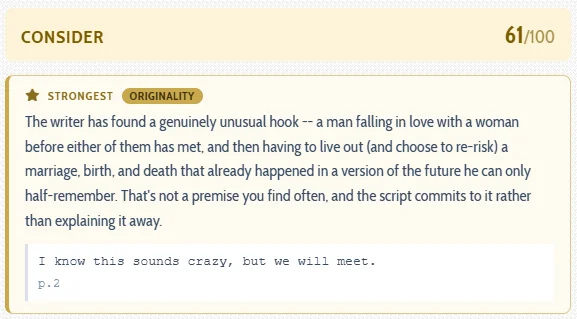
It found them. Not in general terms. It told me which page my inciting incident actually lands on and why that is too late for that particular story. It quoted my own lines back at me, with page numbers, to show me what it meant - the worst exchange in the script and the best one, and what separates them. It named the single thing my script does better than anything else it does, quoted the line that proves it, and told me to protect that through the next draft. Nobody had ever told me that part before.
Then it gave me a detailed to-do list for a subsequent rewrite, each one with the affected pages and roughly how much effort it might take on my part.
Here is an example of actual coverage on one of my scripts - apologies, there is so much of it that it makes a really big image! I am showing you the whole thing on purpose, because the amount of useful detail in it is the entire point.

So, what does our coverage contain?
- A verdict and a score out of 100 - Pass, Weak Consider, Consider, Strong Consider or Recommend, worked out from the seven scores beneath it, with your premise and your originality weighted heaviest, because those are the two you cannot fix by working harder.
- Seven categories, each scored and each argued - premise, structure, character, dialogue, originality, craft and marketability. Not just a number: a paragraph on why that number and not another, with lines quoted from your own pages and the page each one is on.
- The thing you are best at, named on its own and quoted - because notes are good at telling a writer what is broken and bad at telling them what to keep.
- Scene notes in page order, marking where the script is going wrong and where it is going right.
- What to do next - a detailed to-do list for your next draft, each with the affected pages, what it fixes, and whether it is a pass, a few scenes or new material.
- How it reads from outside - a logline as the pages give it, the genre, comparable titles, who the audience is, and an honest note on what a reader could not judge from the page.
It reads the whole screenplay, every page of it, and takes about four minutes.
It is not always flattering
One thing I want to be straight about: two of my own scripts came back a Pass, and it was right both times. If you want a report that tells you your script is wonderful, this is the wrong one. If you want to know what a reader would actually think before you send it out, it is the right one.
I encourage everyone to give it a shot
First, of course, you have to have a completed script at Script 360 - you can easily import both FDX and PDF screenplays, fully formatted.
Then open any script from your dashboard, choose the AI Extras tab, then Coverage. You will see the exact price (in AI Credits) before anything is charged.
- Ben Cahan