
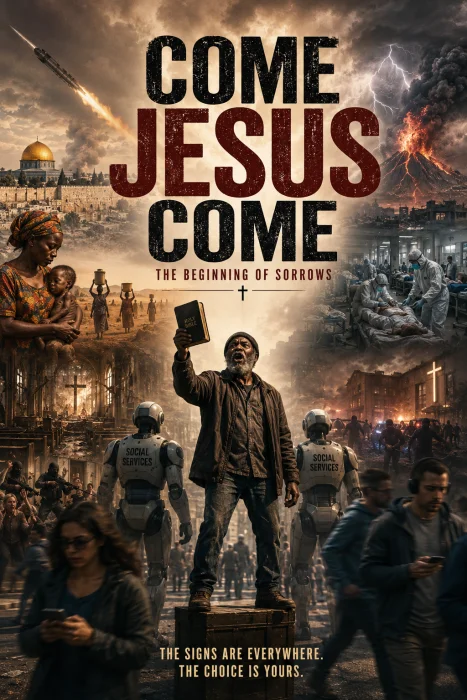

A reader's report, written by Script 360's AI coverage system.
Read 11 September 2026 · from the First Draft draft · 85 pages · read as a Feature Film
The writer's instinct for grafting a specific, imagined near-future onto the well-worn Rapture story — AI enforcement, robot social workers, church-guarding biker militias — is the freshest thing here, and worth protecting even as the rest of the machine gets rebuilt.
Rebels for the Lord!p.37
As AI-driven authoritarianism and biblical prophecy overtake a collapsing America, a grief-shattered family — a guilt-ridden ex-cop, his estranged wife, and his militia-minded brother — scatter into prison, homelessness, and the woods, converging just as the Rapture arrives.
This is an ensemble end-times drama that fuses the familiar Christian-Rapture genre (Left Behind, Revelation Road) with a near-future AI-dystopia skin — humanoid Social Services robots, an AI-revised 'interfaith' Bible, and a biker militia guarding churches. That combination gives the script a genuinely distinctive texture the genre doesn't usually have. What it lacks is a matching structural spine: the story front-loads its inciting tragedy (a toddler's death, funeral, riot, and manslaughter conviction) into the first fifteen pages, then spends the bulk of its length on three parallel, loosely-connected journeys — prison, homelessness, biker militia — that mostly restate the same theological point through different mouths rather than escalating. The strongest material is Emma's odyssey, especially a quiet callback where a stranger's daughter happens to share the dead daughter's name, which earns its emotion without a word of exposition. The weakest is the climax: after forty pages of table-setting about who gets taken and who is 'left to face what's left,' the Rapture arrives and the script cuts to black without ever showing which of its characters go and which stay — a payoff the script itself trained the reader to expect and then withholds. A continuity slip (a five-year newspaper sentence that becomes 'six months' in dialogue) and several scenes that function as theological Q&A rather than dramatized conflict round out the issues. There is a real, specific idea in the worldbuilding here; it needs a structure and an ending built to match it.
Left Behind (2014) · Revelation Road trilogy · Six: The Mark Unleashed · The Book of Eli · God's Not Dead
Faith-based and evangelical film audiences already engaged with end-times prophecy media, likely reached through church screenings, Fathom Events, and Christian streaming platforms rather than mainstream theatrical release.
The opening promises a story about biblical end-times prophecy made literal and immediate, layered onto an America where AI has taken jobs, criminalized scripture, and begun tracking its citizens. That's a workable hook, and the script does keep circling back to it — robots arrest a street preacher on page 3, a radio broadcast puts the Bible 'under review' on page 9, phones later demand facial verification. But the premise is really two premises stitched together (an AI-surveillance dystopia and a family-grief redemption story) and the script never quite decides which one is driving the bus, so the 'what if' of the opening doesn't tighten into a single, escalating question the way a strong premise should. It's a promise of scale (nations, kingdoms, the actual apocalypse) delivered through a very small, domestic lens (one broken family), and that tension is never resolved into a throughline — it's held rather than built.
Nation gon’ rise against nation. Kingdom... against kingdom.p.1 — sets a scale of promise the story mostly narrows away from
A revised interfaith text developed with A.I. is expected to be--p.9 — the specific dystopian hook that distinguishes this from a generic Rapture film
Two humanoid ROBOTS marked “Social Services” make their way toward him.p.3 — premise's most vivid image, delivered early and rarely matched later
Act one is extremely dense — global prophecy montage, Jesse's arrest, the Tanner family setup, Adam's death, the funeral, the riot, and Max's sentencing all land inside the first fifteen or so pages. What follows is not really a second act with a spine so much as three parallel character-tracks (Max in prison, Emma on the road, Sam with the militia) that check in on each other without a clear midpoint reversal — the 'selected inmates will undergo review for early release' beat around page 53 raises hope but is never complicated by an obstacle, so the release simply happens. The biggest structural failure is the ending: the Dunn/Jesse exchange explicitly sets up the reader to expect a clear answer to 'some go, some stay,' and the climax declines to show it. Cutting to black on an embrace and a wash of light reads as an evasion of the very question the middle act spent its time building toward, rather than a deliberate ambiguity the story has earned the right to leave open.
And the ones who stay? / They face what’s left.p.41 — explicit setup of a binary outcome the story owes the audience
The light fills the frame-- CUT TO BLACK.p.100 — the payoff never arrives; the binary is never resolved on-page
THUD. Silence. The tricycle wheel spins.p.11 — the inciting tragedy that should function as a midpoint low instead opens the story, leaving nothing comparable later
Emma has the clearest and most earned arc: she wants to keep a promise to her dead daughter and grandson ('I’m not leaving them here. Alone.', p.25), that want visibly costs her (sleeping under a freeway, drawing a gun on teenagers), and it resolves in a physical, specific gesture — leaving the teddy bear at the grave before she leaves for the camp. Max's want is murkier: he moves from guarded disbelief ('Curiosity’s how people end up in cuffs... or worse.') to guilt ('And I killed my grandson.') but the script never gives him a decisive moment of choice to match it — at the one scene built to force the question, he simply 'doesn’t move.' Jesse, Dunn, and Clayton exist almost entirely to dispense wisdom to Max; none of them wants anything for themselves beyond the one line about wanting release, which is dropped as soon as it's said. That leaves the story's emotional center (Max) the least dramatized character in it, propped up by mentors who function more as pulpit than person.
Curiosity’s how people end up in cuffs... or worse.p.6 — Max's opening want/defense mechanism
I’m not leaving them here. Alone.p.25 — Emma's want, stated and then acted on for the rest of the script
Max stands at the shore. Frozen. Something in him shifts--but he doesn’t move.p.90 — the moment built to resolve Max's arc instead defers it
Jesse has a real, specific voice — vernacular, unhurried, carrying its own music ('They don’t care much for cops in here. Same as the rest.') — and that voice is a genuine asset. But it bleeds into Dunn and Clayton, who share the same cadence of folksy aphorism even though they're supposed to be distinct men from distinct backgrounds, which flattens the ensemble into one wisdom-dispensing register. A lot of the script's worldbuilding is delivered through the radio and newspaper rather than dramatized in scene, which is functional but inert. The best writing in the script is the donut exchange at the food line, where Emma never says she's thinking of her dead daughter — the line does the work by omission, which is the opposite of the newscast approach and the script's clear high point.
They don’t care much for cops in here. Same as the rest.p.17 — Jesse's distinct, effective voice
They grow up so fast... And then one day--you look--and they’re gone.p.51 — the script's best moment of restraint
The President signed an executive order overnight expanding federal hate speech guidelines. Several religious texts--including the Christian and Hebrew Bibles are now under review.p.9 — worldbuilding delivered as newscast rather than dramatized
The genre this belongs to — Rapture-and-Tribulation faith drama — is well populated, but the specific furniture the writer has put in it is not: humanoid Social Services robots arresting street preachers, an AI-generated 'interfaith text,' phones that demand facial verification for food distribution, and, most vividly, a motorcycle militia in Kevlar and Christian flags running perimeter security on a cathedral. None of these are things this genre usually does, and together they give a tired premise real, specific texture. Set against that: the wise Black inmate-mentor with no want of his own, the Native American inmate who exists to deliver spirit-world wisdom, and the ambiguous cut-to-black Rapture ending are all recognizable moves from other faith and prison films. The script is at its most original when it's building its dystopia and at its most conventional when it's building its redemption arcs.
On every bike--Christian flags whipping in the wind.p.37 — a genuinely fresh image for this genre
Two humanoid ROBOTS marked “Social Services” make their way toward him.p.3 — the dystopian-enforcement idea that distinguishes the script
Some folks gotta get shook first... before they see clear.p.33 — an example of the generic mentor-aphorism register that recurs across three different characters
At its best the action writing is lean and does real work — the crosscut sequence of Adam's death compresses dread into fragments and lands hard without a wasted word. Elsewhere the craft is looser: a factual contradiction has Max sentenced to 'FIVE YEARS' in a newspaper insert and then referred to as having gotten 'Six months' in Emma's dialogue a few pages later, which is the kind of thing a continuity pass should catch in a script this reliant on grounded, plausible-feeling collapse. Several scenes (the yard theology debates in particular) are staged as call-and-response exposition rather than scenes with rising stakes, which is a structural problem that shows up at the line level too — nobody in these exchanges is trying to get anything from the other person. A handful of typos appear ('Recalulating' on the gas-station page) but are minor and don't affect the read.
THUD. Silence. The tricycle wheel spins.p.11 — efficient, visual, devastating — craft at its strongest
OFFICER SENTENCED TO FIVE YEARS IN ASSAULT CASEp.16 — contradicted later by dialogue
Six months... and a jury of machines.p.25 — the contradiction — sentence length changes mid-script
There is a real, active market for faith-based end-times films — Left Behind, the Revelation Road pictures, Six: The Mark Unleashed, God's Not Dead — and this script's AI-dystopia angle is a genuine differentiator that could be sold on its poster. But the content is darker than most of that market's core audience is used to: a toddler's death by vehicular accident, a mob beating a man to death, prison violence with real menace. That's a tonal risk for a Christian-film distributor and a mismatch for mainstream buyers who won't engage with the theology. The budget also works against the niche: robots, a missile strike on Jerusalem, a volcanic eruption, and an eight-bike militia convoy all require a VFX and stunt budget well above what most faith-film financiers are used to spending. This is a script more likely to find a specific faith-adjacent distributor than a wide theatrical buyer, and only if the tone is calibrated to that audience's expectations.
Max lands on him. Grabs his collar and POUNDS him. Once. Twice. Three... too much.p.15 — violence beyond typical faith-market tone
Kilauea ERUPTS, spewing ash high into the sky.p.2 — VFX cost that exceeds typical genre budget
Rebels for the Lord!p.37 — a marketable, distinctive image for this specific audience
Decide what the ending is actually saying about who is saved and who is not, and show it on the page — right now the script builds an explicit theological question ('some go... some stay') across its middle act and then declines to answer it at the one moment the entire structure has been pointing toward, which makes the climax feel unfinished rather than intentionally open.
Decide, on the page, who is taken in the Rapture and who is left, and show it rather than cutting to white light and black. If ambiguity is the intent, build toward an ambiguity the audience can feel resolved by (e.g., show consequence for at least one named character) rather than an ambiguity that reads as an unfinished ending.
The script trains the reader to expect a clear answer to exactly this question and then withholds it; right now the ending reads as incomplete rather than deliberately open.
Final 3-5 pages, and the Dunn/Jesse rules established on page 41
Give Max a specific, active choice to make — not just an emotional shift he undergoes, but a decision he enacts on the page (steps into the water, speaks a specific line of belief or refusal, does something with consequence).
Max is the character carrying the story's central guilt, but his arc is currently described in reaction ('something in him shifts') rather than dramatized in action, so his transformation isn't felt.
The lake/baptism sequence (pp.77-90) and the climax
Run a continuity pass on the plot mechanics that are meant to feel grounded and plausible — starting with the sentence-length contradiction (five years vs. six months) and checking the escalation of disasters (earthquakes, tremors) for consistency.
Small factual slips undercut a script that relies on its dystopia feeling plausible and researched.
p.16, p.25, and the tremor beats throughout
Rewrite or cut the repeated theology-explainer scenes (Dunn/Jesse yard debates, multiple Jesse-explains-the-Rapture-to-a-skeptic scenes) so each one either escalates into real conflict between the two speakers or is trimmed — there are at least three separate scenes making essentially the same point.
Repetition of the same theological beat in different mouths flattens momentum across the whole middle section.
pp.17-19, 21-22, 39-41, 53-54
Add a genuine midpoint complication that costs the ensemble something before the reunion — a setback in the early-release track, a real cost to Sam's gun-running, or a threat to Emma that changes her plan — so Act 2 has its own turn rather than three tracks simply accruing incident until they converge.
The sprawling middle currently sustains rather than escalates; a mid-act reversal would give the convergence at the camp more weight.
pp.40-75
Give Jesse a want of his own beyond dispensing wisdom to Max — reinstate and follow through on his one stated desire ('gettin' out,' p.53) as something the plot actually tracks and resolves for him specifically.
As written, Jesse risks reading as a device for Max's arc rather than a person with stakes of his own, which is the familiar weakness of the wise-mentor-inmate archetype.
Prison scenes throughout, especially pp.53-90
Whether the tonal swing between real violence and faith-community warmth plays on screen, whether the VFX-dependent moments (missile strike, volcanic eruption, humanoid robots) are achievable at whatever budget this is intended for, and whether the ambiguous ending is a considered authorial choice awaiting a sequel or simply an underdeveloped final beat — none of that is recoverable from the page alone.
This report was written by Script 360's AI coverage.
Upload a screenplay and get one of your own — scored, evidenced, and quoting your own pages back at you.
Try it on your script