

A reader's report, written by Script 360's AI coverage system.
Read 18 September 2026 · from the First Draft · about 81 pages · read as a Feature Film
This writer's real gift is inventing a genre mechanic that isn't borrowed — a cosmology of consciousness-as-content that formally rhymes with its own protagonist going viral, so the story's plot and its metaphor are the same shape.
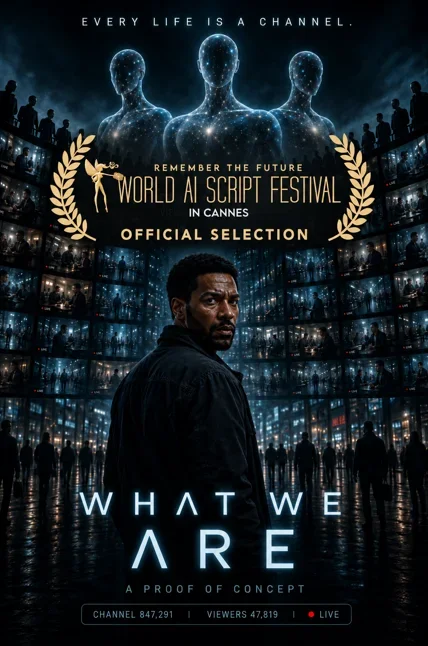
EVERY LIFE IS A CHANNEL.p.123
A structural engineer's compulsive need for explanations leads him to discover that human consciousness is being experienced as entertainment by beings from another reality, and that letting them know they've been seen back may be catastrophic.
This is a quiet, dialogue-driven sci-fi mystery that earns its early scenes through specificity — a man who logs everything, a waitress who calls him on his bullshit, a running joke about the phrase 'I'll see' — before opening out into a genuinely inventive cosmology about consciousness as a viewed commodity. The two leads, Jalen and Mira, are well-drawn and talk like people; the concept, once it declares itself, is not a rehash of ghosts or aliens but something closer to a metaphor for the attention economy made literal. Where it struggles is in the machinery around that idea: the middle act repeats its 'nothing happened' testing beats several times without escalating, a job-jeopardy subplot at Jalen's firm gets raised and then dropped for three months, and the abstract Viewer Realm scenes frequently describe internal states ('Interest increases') that a camera has no obvious way to render. The personal grief thread that opens the film — did something watch my parents die — pays off in one strong scene at the cemetery but then gets compressed into a couple of lines after the global climax, so the ending feels more like relief that the world didn't end than a resolved reckoning with loss. It's a script with real strengths in voice and idea, needing tightening in structure and clarity in its most conceptually important scenes.
Arrival · Coherence · The Endless · Nope
Viewers who like grounded, relationship-driven sci-fi mysteries handled through conversation rather than spectacle — the Arrival/Coherence audience rather than a tentpole crowd.
The promise of the opening — a man who cannot stop noticing when something doesn't add up, catching what might be a presence in a hallway mirror — is a small, credible hook that earns the larger reveal instead of front-loading it. The eventual idea, that human experience is being watched/consumed as entertainment by an audience in another reality, and that mutual visibility between watcher and watched is dangerous, is a genuinely fresh angle on 'being watched' rather than a ghost story or an alien-invasion story in disguise. The script keeps this promise disciplined for a long stretch, letting Jalen and Mira build the case slowly rather than showing the entity early, which is the right instinct for this kind of premise. It's a small, specific, well-earned idea rather than a vague one, and it's worth the length of a feature.
CHANNEL 847,291 VIEWERSp.13 — The core conceit rendered as a concrete image, not an abstraction
You're watching us. All of us.p.41 — The premise stated plainly once it's earned
Fragments. A birthday cake. Someone else's laughter. Gone.p.41 — The scale of the idea shown through montage rather than exposition
The emotional core is Jalen's need to know whether his parents' deaths were witnessed by something, and whether he can survive not knowing — that's the feeling the film wants a reader to carry out. The scene where it should land hardest is the cemetery confrontation, and it does land: 'You don't get to have this' is the sharpest, most specific line of grief in the script, staged as action rather than stated as theme. The ending tries to pay this off with 'I think I'm finally okay not knowing yet,' but the cost that earns that line is mostly the near-catastrophe of the Look Back rather than further work on the grief itself — the personal thread gets one short scene after the global climax rather than a dedicated final beat of its own, so the payoff feels a little unearned relative to how much of the film's first act it seeded. What the script argues — that the need for certainty is itself a wound, and peace requires tolerating unresolved loss — is mostly dramatized through Jalen's obsessive documentation rather than speeches, which is the right choice; the ending simply doesn't spend quite enough time cashing that argument in before the credits.
You don't get to have this.p.54 — The theme staged as confrontation rather than stated
I still don't know where you went.p.120 — The unresolved grief acknowledged directly
I think I'm finally okay not knowing yet.p.120 — The thematic resolution, arriving quickly after the plot climax rather than through its own scene
Act one is efficient — the sensor-12 subplot, the mirror glimpses, the diner meeting with Mira all land within the first act and set up the film's real spine (isolation vs. attention) cleanly. The midpoint, Jalen's first clear visual contact ('You can see me'), is a properly placed escalation, and the third act's Look Back sequence is a legitimate structural climax with real stakes. Where it sags is the investigative middle: the park bench, the camera test, the low-stimulation test, and the fridge-cleaning beat all repeat essentially the same 'nothing happened, then something did' rhythm without meaningfully raising the stakes between them. A subplot about Jalen's job being jeopardized by the video is introduced with real weight ('I'm putting you on paid leave for the rest of the week') and then simply never resolved on the page — three months later he's just back at his desk. The epilogue compresses a great deal of necessary closure (Jalen's job, his grief, the world's adjustment) into a handful of very short scenes.
I'm putting you on paid leave for the rest of the week. We'll reassess Friday.p.70 — A stake introduced and never paid off on the page
How long? Forty-three minutes. Good.p.26 — One of several similar 'we waited, nothing happened' beats that don't escalate against each other
Riverside. Sensor 12? Still thermal expansion.p.119 — The job-jeopardy thread resolved by omission rather than scene
Jalen has a genuinely specific want that sharpens across the script — he isn't chasing an entity in the abstract, he needs to know whether something was present during his most private moments of grief with his dead parents ('I went because I needed to know if they were there when I thought I was alone'), and his flaw (he cannot stop looking even when told to) is what actually endangers Mira, her children, and eventually the world. That's a character whose obsession has real consequences, not just quirk. Mira is the strongest asset in the cast — she has her own life, her own rules for the investigation, and her own independent decision to go public that Jalen explicitly does not get to make for her: 'If I stay quiet because I choose to protect my kids, that's my decision.' Nate and Derrick are each given a consistent, distinct function (comic warmth, loyal skepticism) but thin out badly once the plot goes global. The entity itself, the Primary Viewer, is a deliberately non-human antagonist whose only real character beat is fear and, at the very end, a small flicker of its own curiosity — which is thematically coherent but means the back half of the script has almost no active opposition with a point of view of its own.
I went because I needed to know if they were there when I thought I was alone.p.56 — Jalen's want stated with precision, tied to the specific grief
If I stay quiet because I choose to protect my kids, that's my decision. If I speak because I think it matters, that's also my decision.p.86 — Mira asserting agency rather than serving Jalen's story
Those are people? Obviously. I apologize.p.31 — A small, character-revealing exchange that costs nothing to the plot but everything to the voice
The dialogue is the clearest strength here — Jalen, Mira, Nate, Derrick, and Sethi each have a distinguishable rhythm, and the running bit around 'I'll see' does real character work across many scenes without ever being explained. The best material is the smallest: the bridge-building scene with Marcus, the unicorn drawing exchange with Kennedy, Ashley's diner one-liners. These scenes let character emerge through specificity rather than statement. The weakest dialogue is exactly where the film has to say its own concept out loud — 'I believe something is accessing human consciousness from outside the reality we normally perceive' — and to the script's credit it knows this is a problem and has Mira interrupt it on the page ('You lost me at human consciousness'), which is a clever, self-aware fix, but the underlying line is still expository even after the joke about it.
That's practically a commitment. Legally, it isn't.p.5 — Character-revealing banter that does double duty as exposition-free scene-setting
Rectangles move. Triangles don't. That's cheating. That's engineering.p.30 — The film's best kind of dialogue — specific, small, and true to the character's mind
You lost me at human consciousness.p.67 — The script self-flagging its own exposition problem without fully solving it
The mechanic at the center of this script — viewers in another reality experiencing human lives as channels, with counts that rise and fall based on emotional intensity — is a genuinely inventive engine, not a dressed-up ghost story or alien-visitation plot. What makes it more than a clever gimmick is the formal rhyme the script builds: Jalen becomes an object of human mass attention (a viral video, a livestreamed event) at exactly the same moment the story reveals he's an object of non-human mass attention, so the plot's escalation and its metaphor are doing the same work. That's a smart, largely unremarked-upon piece of construction. The back half's shape — a private phenomenon goes viral, a scientist gatekeeps the claims, a global 'event' spirals — is a familiar contagion/viral-phenomenon template, but the specific content poured into that shape (the danger being mutual visibility rather than exposure or contamination) is this writer's own.
EVERY LIFE IS A CHANNEL.p.123 — The metaphor stated as the film's actual final line
We were right about that. There's more. I saw where it was.p.99 — The idea developing new implications rather than just being reasserted
184,209 VIEWERS.p.84 — The viral-video and cosmic-viewership counts deliberately mirroring each other
The prose style for Jalen's ordinary life is genuinely effective — short, clipped fragments that read like a hyper-vigilant, list-making mind: 'Not waking.\nAlready awake.' That rhythm carries the reader well through the domestic and workplace scenes. The problem is the Viewer Realm material, which is the conceptual heart of the script but is frequently written as internal narration a camera has no clear way to stage: 'Something about their interaction attracts attention.\nInterest increases.' These lines tell a reader what to feel about an abstraction rather than showing an image, and there are enough of them that the film's most important space is also its least visualized. There are also several places where dialogue cues and stage direction run together without a line break in a way that momentarily confuses who's speaking or acting, which is a formatting issue rather than a voice issue but slows the read.
Not waking. Already awake.p.1 — Fragment style working well to convey a mental state
Something about their interaction attracts attention. Interest increases.p.24 — Abstract telling in the script's most important recurring location
You're trapped now. A paper plate appears in Jalen's hand.p.8 — Dialogue and action description fused without separation
The script tracks its own internal rules with real discipline — attention and emotional intensity raise the viewer count, isolation and boredom lower it, and this is paid off consistently from the fridge-cleaning test to the climactic Look Back. But the actual mechanism by which 'reciprocal attention' causes millions of people to briefly share each other's sensations is asserted rather than explained, which the script partly excuses by having its characters repeatedly say 'we don't know' — a defensible choice thematically, less so as plot mechanics for a global-scale event. Several threads are opened and dropped: Elaine's disciplinary threat at Bracken, Luis's 'I thought it was just me' moment at the diner, Ashley's growing involvement — none of these get closure, they simply stop appearing. The Sensor 12 parallel is a nice piece of tightness that does pay off cleanly and is worth keeping as a model for how the rest of the plumbing should work.
Thermal expansion at the connection.p.29 — A clean, well-paid-off piece of mechanical logic used as a character metaphor
I'm not putting you on any kind of notice, this is just space.p.70 — A stake raised without a later scene closing it
I thought it was just me.p.98 — A character introduced as a data point and then dropped without further use
This reads as a contained, two-lead genre picture — a talky, character-forward sci-fi mystery that could be shot largely on practical locations (an apartment, a diner, an office, a cemetery) with a single, relatively cheap large-scale sequence for the Look Back climax handled mostly through news-broadcast and phone-footage montage rather than effects. That's an attractive budget profile for a specialty distributor or streamer looking for 'elevated sci-fi' in the vein of grounded, dialogue-driven anomaly stories. Both leads are gettable, mid-budget roles for name talent, and the Mira character in particular is an unusually well-written supporting/co-lead part for a woman in this genre. The risk is the ending: no villain is defeated, nothing is definitively proven, and the film closes on a deliberately unresolved cosmic note, which will read as satisfying to a specialty audience and frustrating to anyone expecting a clean genre payoff.
MY NAME IS JALEN. I'M THIRTY-FOUR YEARS OLD. I'M A STRUCTURAL ENGINEER.p.65 — A grounded, non-genre-typical lead voice that's castable and specific
Something happened. We don't know what it was.p.118 — The film's deliberately unresolved final public statement — a specialty-audience ending, not a mainstream one
Tighten the middle act so its testing scenes escalate rather than repeat, and give the grief thread its own closing beat before the epilogue — right now the personal cost the film opened with gets resolved almost entirely as a byproduct of surviving the global crisis, when it's the strongest material in the script and deserves its own scene.
Consolidate the middle-act 'nothing happened' testing beats (park bench, camera setup, low-stimulation test, fridge-cleaning) into fewer scenes that each escalate the stakes or reveal something new, rather than repeating the same rhythm.
This is where the pace sags most; several scenes currently do the same job.
Pages roughly 20-45
Give the Elaine/Bracken job-jeopardy subplot a closing beat instead of letting it disappear for three months — either an on-page consequence or an explicit scene where it's resolved.
A real stake is raised and never paid off, which reads as an oversight rather than a choice.
Set up p.70, dropped until p.119
Add a dedicated beat for Jalen's grief thread after the Look Back climax and before the three-months-later montage, so the acceptance in the final cemetery scene is earned by its own scene rather than arriving as a byproduct of surviving the global event.
The personal thematic payoff currently feels compressed relative to how much of act one it set up.
Between the studio climax and the epilogue
Rework the Viewer Realm interludes to stage 'attention' and 'interest' as visible, physical action (movement, positioning, a gesture) rather than narrated abstraction.
Currently these scenes tell a reader what's happening emotionally rather than showing something a camera could capture.
All Viewer Realm scenes throughout
Decide deliberately what the extreme-pullback cosmic coda is doing relative to the intimate diner ending immediately before it — either build a transition into it or trim it to a shorter, quieter sting.
As written it risks undercutting the earned personal ending with an unresolved cosmic escalation delivered with no setup.
Final two pages
Audit the 'pitch to camera' scenes where Jalen explains the concept aloud, and find visual or structural ways to interrupt or undercut them beyond Mira's meta-commentary alone.
The lines are still expository even when the script lampshades the problem.
The video-recording scenes, pp. 65-67 and 76
How the Viewer Realm's abstract descriptions would actually resolve on screen depends entirely on directing and visual-effects choices not specified on the page. It's also impossible to know from the page how a mainstream audience will react to an ending that offers no definitive proof or antagonist defeat, or how two relatively unknown leads would be perceived by financiers weighing the project against more conventional genre packages.
This report was written by Script 360's AI coverage.
Upload a screenplay and get one of your own — scored, evidenced, and quoting your own pages back at you.
Try it on your script