
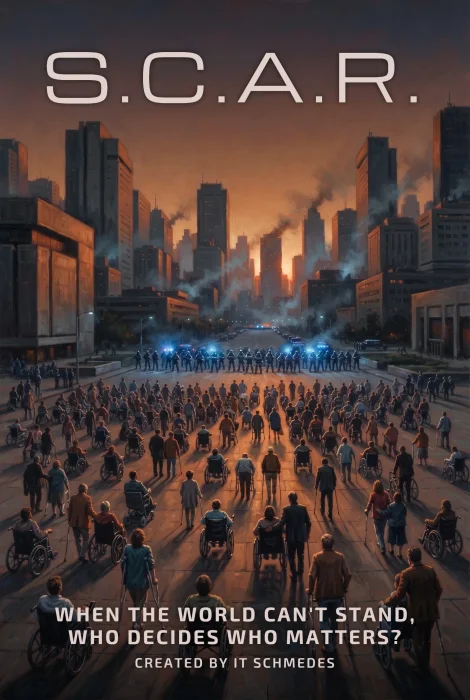
The global crisis of SCAR is shown through the eyes of three Romanov siblings. Alex is a brilliant young programmer who is serving time for cyber crimes is released from jail on the Presidential "SCAR Emergency Measures act" to provide care for the growing sick population in public SCAR care unit. Alex struggles with depression and failed attempts to reconnect with his estranged sister Sonia, an overworked physician who works exceedingly long hours due to growing "professional power crisis" induced by the SCAR epidemic while taking care of their SCAR demented mother at home and raising the youngest sibling Nikolai, who is acutely affected by everything that's happening in the world and is desperately trying to find its place and purpose in it.
In an America where a mysterious epidemic hollows millions into screen-fixated husks, the government's answer isn't a cure — it's a bill to legislate the afflicted out of existence.
S.C.A.R. opens on a premise sharp enough to carry a series by itself: a neurological plague has turned a generation of Americans into catatonic husks, staring at screens until someone else feeds them, and the state's response to the labor and cost of caring for them is a piece of legislation with a name as blunt as its intent — the Human Liquidation Act. That's the engine. Everything else is what happens to people standing inside it.
Alex Romm is a paroled hacker, brilliant and combustible, sentenced to work off his debt to society inside the very SCAR facility where his estranged sister Sonia is a resident physician. He wants back into the family he wrecked; what he needs is to stop being the reason it stays wrecked. Sonia, meanwhile, is drowning — a catatonic mother at home, a collapsing hospital at work, a boyfriend who's decided euthanasia work might be a reasonable career move, and a brother whose reappearance she has no bandwidth to forgive. Their reunion isn't a reconciliation. It's two people who love each other with no room left to show it, and a kid brother caught between them who's starting to look for family somewhere worse.
That kid brother, Niko, gives the pilot its third rail: while Alex chases redemption and Sonia holds the line, Niko drifts toward a doomsday cult whose leader promises the belonging his actual family can't currently spare. By the end of the hour, Alex has torched his own progress in one act of righteous violence and been bailed out by a shadowy tech consortium with its own designs on the epidemic, and Niko has wandered, unwatched, straight into the arms of a man calling himself the Truth Messenger. Nobody is saved. Everybody is compromised. That's the show.
It's a family drama wearing the bones of dystopian satire, and it never lets the satire do the emotional work — the stakes are always a specific mother, a specific brother, a specific parole officer, not an abstraction. The result sits comfortably alongside The Leftovers, Station Eleven, and Utopia: catastrophe as the backdrop for the much smaller, much harder problem of whether people can still take care of each other.
A story about a system that responds to an overwhelming care crisis by deciding certain lives are no longer worth the cost lands as more than metaphor in a moment already arguing about who gets care and who gets triaged out of it.
Alex is the part actors circle twice — a genius wired for self-destruction, given one real shot at being someone his family can stand to be around, and not quite able to stop himself from blowing it. It asks for menace, humor, and grief in the same scene, often the same line.
Viewers who followed The Leftovers and Station Eleven into prestige dystopia for the family wreckage at the center of the catastrophe, not the catastrophe itself.
The Leftovers · Station Eleven · Utopia
Loading…
Loading…
Loading…
The tabs in this section are currently hidden. Click on any of the tab titles above to open one.
Read 22 September 2026 · from the First Draft · 58 pages · read as a 1 Hour Episodic TV The script has been edited since this was written.
This writer's real gift here is world-building through a genuinely strange, resonant central conceit — SCAR isn't just a plague, it's screen addiction made literal and lethal, and every institution in the script (prisons, hospitals, congress) has to reorganize itself around that fact.
Ray's eyes gain focus but only on the tablet's screen. His eyes dart back and forth. Is he reading? It's hard to tell. His fingers scroll and swipe on the screen. The images seem to move too fast for him to be reading.p.6
As a mysterious epidemic turns victims into device-obsessed catatonics and the government drafts nonviolent felons to nurse them, a resentful medical resident, her paroled hacker brother, and her drifting teenage brother are each pulled toward a different answer to the same question: what do we owe people who can no longer answer for themselves.
This is an ambitious ensemble pilot that uses a literalized 'screen zombie' plague to stage a live argument about euthanasia, labor, family obligation and tech addiction, and it does genuinely have an idea worth building a season around. The teaser with the Johnsons is the strongest writing in the script — quiet, specific, and dread-soaked — but that couple then vanishes from the narrative almost entirely, which is symptomatic of a pilot juggling more threads (Johnsons, Sonia/Raj, Alex/Crazy Horse, Niko/BTR, the Infinite Order tease) than it has room to connect. The Sonia-Alex-Patricia material is the emotional backbone and mostly works, though it is delivered in accusation-heavy speeches rather than fully staged scenes. Dialogue swings between flat exposition ('It's only the nonviolent ones' / 'Spare me. Today it's the nonviolent ones, then what?') and real voice (Crazy Horse's conspiracy patter, Jamal's patois). The world-building is clever but frequently explained rather than dramatized — news inserts and stump speeches do a lot of the thematic heavy lifting. It reads like a strong premise in a first draft that hasn't yet decided which of its five plots is actually the spine.
The Leftovers · Utopia · Station Eleven · Mr. Robot · Black Mirror
Viewers of socially-conscious speculative ensemble dramas who want a topical, morally uncomfortable premise (healthcare rationing, prison labor, euthanasia debates) alongside family melodrama, rather than a straight horror or action take on an outbreak.
The core idea — a disease that turns people into non-responsive device zombies, arriving at the exact moment society is already addicted to devices — is a genuinely sharp metaphor and it's introduced with real confidence: we see it happen to an ordinary man mid-sentence before we understand any of the rules. The script then builds out real institutional consequences from that idea rather than just gesturing at them: a professional power shortage that requires releasing prisoners into 80-hour caretaking shifts, a congressional fight over a Human Liquidation Act, a 911 operator who calmly tells a grieving wife to order a 'SCAR care kit' online. That's a premise that generates plot on its own, scene after scene, without needing to be re-explained. The pilot's biggest achievement is making the mundane bureaucracy of this world (clock-in thumbprints, food coupons, laundry schedules for scrub pairs) feel more frightening than any monster would. Where it's slightly undercut is that the actual cause/mechanism of SCAR is left completely opaque even as a hook — which is fine for a pilot, but the show hasn't yet shown its hand on what kind of answer it's chasing (medical? technological? spiritual, given the BTR material?). Still, as an opening promise — a plague literalizing our relationship to screens, forcing a debate about who still counts as a person — this is the strongest thing in the script by a clear margin.
The SCAR Emergency Measures Act, Part II, signed by the President on October 17th, officially went into effect today...will deliver the workforce needed to address the Professional Power Shortage crisisp.2 — establishes the institutional machinery generated by the premise
Due to the professional power shortage we no longer send out crews for new onset SCAR cases. Take your husband to the nearest SCAR care facility, or if you choose to care for him at home, you can find information and order a SCAR care kit through scar.org.p.7 — the premise made bureaucratically, chillingly concrete
This is not a picnic in the park. This is an eighty hour work week.p.12 — the prisoner-labor consequence of the premise, stated plainly and used as a real stake
The emotional core the script is reaching for lives in the Romm family — specifically, whether a person who has been genuinely hurt is obligated to let a repentant sibling back in when she is already drowning in unpaid caretaking labor. Sonia's raw accusation to Alex — 'You've been the black cloud in my life ever since I was born. But I'm free from you now, and I'm not gonna let you corrupt Niko' — is where the script wants that feeling to land, and it partially does: the scene has real heat and a legible, ugly history behind it. But it arrives almost entirely through direct statement rather than through action the audience has watched happen, so it reads more like backstory delivered under pressure than a wound reopening in real time. The stronger, more dramatized version of the theme is actually in the Raj/Sonia breakup, where the argument about euthanasia is staged as an actual choice with consequence rather than a speech: Raj circles option B on a literal survey, and the fact that he did it in secret, and his justification ('They wouldn't take your mother, she doesn't cost the government money') is a real, quiet gut-punch that argues something specific — that compassion becomes negotiable the moment it's expensive. The larger thematic frame (the Gorman/Stein debate, the Truth Messenger's sermon) states its ideas outright rather than letting the plot argue them, which is the category's main weakness: 'Who wants to live in a world without love and compassion?' is a thesis statement, not a dramatized cost paid by a specific character.
You're a destroyer, Alex. You poison everything you touch.p.37 — the family wound stated directly rather than shown accumulating
They wouldn't take your mother, she doesn't cost the government money --p.47 — the theme dramatized through a specific, ugly, earned choice
Who wants to live in a world without love and compassion? Who wants survival at any price? If it costs them their souls? Not I.p.27 — theme delivered as rhetoric rather than staged through character stakes
The four-act shape is functional for the format: the teaser plants Ray's collapse, Act One ends on his seizure crisis (a real escalation), Act Two ends with Niko vomiting in the wreckage of the riot he helped ignite, Act Three ends with Alex's arrest after the assault, and Act Four scatters three separate cliffhangers (Alex bailed by Infinite Order, Niko vanished into the cult, Sonia screaming into a police clerk's indifference). That's a reasonable engine for episodic television, designed to leave threads dangling rather than resolve. The structural problem is that the Johnson family, given the entire teaser and a full scene in Act Two, is never integrated into the other storylines beyond one bureaucratic hallway confrontation with Sonia — they function as a standalone cold open rather than a thread the structure is actually built around, so their emotional investment is largely wasted by Act Three. The five simultaneous plots (Johnsons, Sonia/Raj, Alex/Crazy Horse, Niko/BTR, the Gorman/Stein debate) are given roughly equal screen time without a clear hierarchy of whose story this actually is, which dilutes momentum in the middle acts. Some individual escalations, though, are well-built — the sitter-negotiation scene with Clara doing real structural work by quietly raising the stakes on Sonia's finances before the Alex confrontation that follows it.
END OF ACT ONEp.24 — the Ray Johnson crisis lands the act break cleanly
Niko bends over and vomits.p.40 — Act Two's escalation is physical and earned by the preceding chaos
PAM: What ya'll have is a shortage of kindness.p.30 — Pam Johnson's only real payoff scene before she disappears from the narrative
Sonia has the clearest and most concrete want in the script — keep her mother alive and cared-for on a resident's salary, keep Niko in school, keep Alex out of her life — and every scene she's in tests that want in a specific, material way (a sitter demanding a raise she can't afford, a brother she can't turn away from the door, a boyfriend willing to euthanize patients like her mother). Niko is also legible: an eighteen-year-old drowning in caretaking responsibility he never asked for, quietly closeted, starved for attention, which makes his drift toward Mason and the cult read as consequence rather than random plot placement. Alex is thinner — his arc oscillates between 'genius who's given up' and 'man desperate to reconnect,' but the suicide attempt that opens his introduction is never referenced again, so it's unclear what that specific brush with death is supposed to have changed in him by the time he's popping NTEX-50 and brawling with Crazy Horse. Crazy Horse himself curdles from comic conspiracy-theorist ('The Russians and Saudis, man') into an attempted rapist with no scene in between establishing that capacity, which reads as a plot device to give Alex a fight rather than a character turn that was seeded. Raj's heel-turn from sympathetic boyfriend to utilitarian is efficient but abrupt — we never see him wrestle with the survey before we see the checked box.
Clara, I can't afford more than two toppings when I order pizza, so I certainly can't afford to pay you three dollars more an hour.p.33 — Sonia's want made concrete in a single specific detail
I have a better idea. How about I get a job? Help you pay for Clara and with the rent.p.44 — Niko's want (autonomy, usefulness) stated clearly and tied to the family's actual economics
Alex is taken aback...it hits him harder than what he was prepared for.p.36 — an internal beat described but not dramatized through specific action
The dialogue is at its best in the margins — Crazy Horse's conspiracy monologues ('The Soviet's been developing the technology since the sixties') have a real, specific rhythm distinct from everyone else in the script, and Jamal's 'Ya Mon' patois, while broad, gives the Limitless Lounge scene a texture nothing else in the pilot has. The teen banter between Niko and MJ over Grindr profiles is loose and funny and sounds like actual teenagers rather than mouthpieces. The weak end of the range is the expository marital dialogue in the Johnson bedroom scene, which spells out plot mechanics the audience could infer ('you can't really catch it since they say it ain't contagious. So you don't so much catch it as you just get it') and the political-speech dialogue at the protest, which reads as position papers rather than people talking to a crowd ('This is a crisis, and every crisis is a morality test of our humanity'). The Sonia/Alex confrontations lean hard on accusation-as-information ('You have no idea what I've been through') rather than letting subtext carry the same weight.
Some people say it's the Chinese. Hell, yeah. Those fuckers are all about world domination.p.22 — a distinct, consistent character voice
Well, see, you can't really catch it since they say it ain't contagious. So you don't so much catch it as you just get it.p.8 — dialogue doing mechanical exposition instead of character work
This is a crisis, and every crisis is a morality test of our humanity.p.27 — speechifying rather than a person addressing a crowd
The central conceit — catatonia caused by (or manifesting as) compulsive screen behavior — is a genuinely fresh spin on the outbreak-drama subgenre, and the specific detail of victims producing 'a string of unintelligible text - a medley of letters, numbers, symbols and emojis' is a strange, unsettling image nobody else has quite used this way. But the machinery built around that idea leans on very familiar parts: the cult with an enigmatic female prophet delivering apocalyptic sermons by firelight, the legendary reclusive hacker being courted by a shadowy tech cabal, the tattooed biker with conspiracy theories, the corrupt-official congressional debate staged as dueling rally speeches. None of these individual elements are badly executed, but none of them are new either, and the script doesn't yet seem to know that its single most original element (the disease concept itself) is doing more work than the genre furniture surrounding it. The Infinite Order tease at the very end promises the show might do something more unusual with the hacker-cabal idea than the standard 'shadowy organization' trope, but the pilot doesn't show its hand on that yet.
she has produced a string of unintelligible text - a medley of letters, numbers, symbols and emojisp.6 — a genuinely original, unsettling image specific to this premise
The TRUTH MESSENGER, enigmatic and magnificent, like a cross between Khaleesi and Joan of Arc.p.61 — a stock cult-prophet archetype named almost as a comparison in the stage direction itself
Who used GANS to create intelligent malware? Whoa, dude. I can't believe it. You're like a legend around here.p.41 — the reclusive-genius-hacker trope delivered without a fresh angle
Most of the action description is lean and functional and moves the eye down the page well — the SCAR facility introduction ('long rows of cubicles filled with SCAR victims, now ghosts of their former selves') does its job in a single line. The teaser is the cleanest writing in the script: short, controlled sentences that let the horror of Ray's collapse land without commentary. Elsewhere the style gets baggier — news-insert scenes and rally speeches run long in block form and slow the read rather than propel it, and a few descriptive choices reach for a novelistic interiority a camera can't actually show ('Suicides notes are notoriously difficult to get right' is a nice aside, but 'Alex is taken aback...it hits him harder than what he was prepared for' describes a feeling rather than showing us the behavior that would convey it). The script's formatting is occasionally sloppy in ways that interrupt the read rather than just needing a polish — dialogue and character cues run together without proper breaks in a few places (the Mystery Man/Alex car exchange collapses 'ALEX CIA?' into one unbroken line).
long rows of cubicles filled with SCAR victims, now ghosts of their former selvesp.12 — efficient, visual world-building in a single line
Suicides notes are notoriously difficult to get right.p.10 — a sharp, dryly funny piece of description that earns its place
ALEX CIA?p.55 — a formatting slip that breaks the read
The biggest logic gap is Pam and Ray Johnson: given a full teaser and a return scene, they're set up as if they matter to the larger story, and then vanish — Ray's fate (brain damage from the missed seizure) is never resolved and Pam never resurfaces, so the emotional investment placed there in the opening pages pays off nothing by the end of the episode. The NTEX-50 drug subplot is introduced with some care (Jamal's warning that 'the cops don't know about it yet') but never complicates anything beyond giving Alex a mood boost before the Crazy Horse fight — it doesn't affect the parole officer's decision, doesn't recur, and the 'righteous anger' line undercuts the drug's narrative purpose rather than deepening it. Crazy Horse's turn to attempted assault of a patient is a significant plot event with zero foreshadowing beyond generic menace, which makes it feel engineered to give Alex a fight rather than something the story earned. The mysterious Mystery Man/Woman bailing Alex out (identity, resources, motive all withheld) is a fair pilot-ending hook, but it arrives without any prior indication that Infinite Order was tracking Alex specifically, which makes the save feel like plot convenience dressed as mystery.
Sonia's face shows distress at the news... What do you mean, starting today?p.9 — sets up Alex's assignment cleanly, but the parallel Johnson thread it interrupts is never returned to
The cops don't know about it yet so your piss in a cup will be safe.p.42 — drug subplot set up with specificity but not paid off structurally
Crazy Horse tries to pull his pants up just as -- Alex SLAMS him down on the floor.p.49 — a major character turn with no prior seeding
This sits comfortably on the socially-conscious sci-fi/dystopia shelf that streamers have built a real appetite for — pandemic-adjacent anxieties, healthcare labor shortages, prison-to-workforce pipelines, and a euthanasia debate all give it a topical hook that a buyer could pitch in a sentence. The ensemble structure (estranged siblings, a marriage in crisis, a teenager radicalizing into a cult, a moral debate at the top of government) is the kind of multi-thread premise that suits a straight-to-series order rather than requiring a pilot to prove itself alone. It doesn't have a marquee performance-driver role or a single starry hook the way some comparable properties do, and the crowded field of "society collapses around a mystery illness" shows means this needs a distinctive visual identity and a starker point of view to stand out at the pitch stage rather than read as one of several similar submissions. As written, it's a reasonable, not exceptional, sell: a genuinely interesting premise that needs a tighter, more confident draft behind it before a buyer would commit past a general meeting.
Riots turned violent in cities all across America today, after the proposal of the controversial Human Liquidation billp.1 — immediate, legible topical hook for a buyer
This is not a picnic in the park. This is an eighty hour work week.p.12 — a distinctive institutional hook (parolee caretakers) that differentiates it from a generic outbreak drama
Decide which of the five threads is actually carrying the emotional weight of this pilot — right now the Sonia/Alex/Patricia material, the Raj breakup, the Johnsons, Niko's cult drift, and the protest-square debate are given nearly equal weight, and the strongest scene in the script (the Johnson teaser) belongs to the thread that gets abandoned. Committing to the Romm family as the spine, and either cutting or meaningfully reconnecting the Johnsons, would let the theme (what do we owe people who can't answer for themselves) land through sustained character stakes instead of being distributed thin across five separate speeches.
Decide whether the Johnson family is a real thread or a one-scene cold open, and either weave Pam and Ray back into the main plot (through Sonia's caseload, the liquidation debate, or Alex's ward) or trim their footprint so the investment placed in the teaser isn't abandoned.
As written, a full act of screen time and a strong emotional hook are spent on characters who never reconnect to anything, which reads as a structural loose end rather than a deliberate ensemble choice.
Teaser and pp. 6-9, 30
Seed Crazy Horse's capacity for violence/predation earlier — one unsettling beat with a patient or an aside from Alex noticing something off — so his turn at the wash station is a reveal rather than a device.
Currently the assault exists to give Alex a fight scene; giving Crazy Horse one earlier, quieter warning sign would make the moment character-driven instead of plot-driven.
pp. 20-23, 49
Convert at least one of the two big ideological set-pieces (the Gorman/Stein rally, the Truth Messenger sermon) from a speech into a scene where the theme is fought out through a specific choice with consequence, the way the Raj survey scene already does.
The script already knows how to do this (Raj's answer to the survey) — applying that same technique to its other big thematic statements would stop the pilot from telling the audience what to feel.
pp. 27, 61
Either pay off the NTEX-50 subplot (have it affect the parole hearing, complicate a later relationship, or recur) or cut it down to a smaller character beat that doesn't promise a consequence it doesn't deliver.
Right now it's introduced with specificity ('the cops don't know about it yet') that primes the audience for a payoff that never arrives.
pp. 42-43, 49-53
Give Alex's suicide attempt a visible echo later in the episode — a moment where the numbness that nearly killed him resurfaces before the NTEX-50 or the fight — so his arc reads as continuous rather than as separate incidents.
Ties his opening to his later behavior and makes the drug use and the violence feel like symptoms of the same wound rather than plot beats.
pp. 10, 42, 49
Clean up the handful of places where dialogue cues and action collapse together on the page (e.g., the car scene with the Mystery Man/Woman), and trim the news-insert and rally-speech blocks to keep pace with the rest of the pilot's leaner scenes.
A few formatting slips interrupt an otherwise clean read, and the speechified sections are the slowest parts of an otherwise well-paced draft.
pp. 27, 55
Whether the tonal mix of broad comic relief (Jamal, Crazy Horse, the Front Desk Bitch) against the bleaker family and euthanasia material would actually cohere on screen, whether the ensemble's five storylines are meant to converge in later episodes, and how a director would balance the newsreel/political-speech material against the more intimate scenes — all of that depends on choices beyond this single episode's pages.
The 8 main characters and 20 minor characters (on the Minor tab) have been added to this script’s Characters list, with whatever the script gave us about each of them. Open one to change anything or to fill in the rest.
This screenplay lives on Script 360.
Write it, break it down, sketch its characters and get coverage on it — then send a page like this one to anybody you like.
Start your own screenplay