
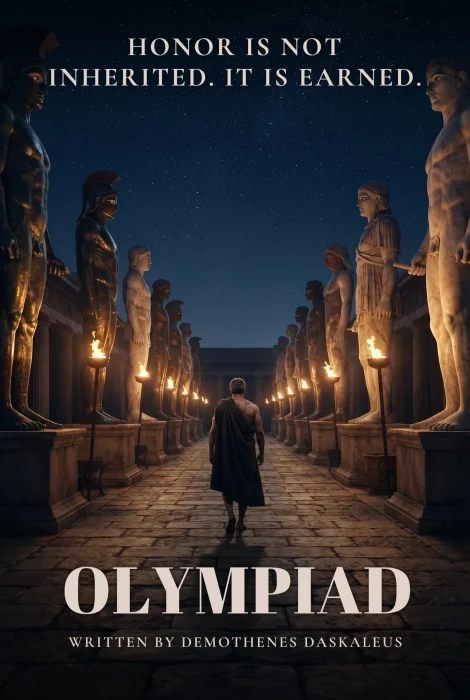
To keep his seven-year-old brother from inheriting the family's shame, a crippled Spartan must win the Olympics' most brutal event — in a city that would rather watch him die than see him quit.
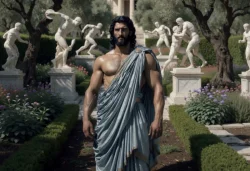
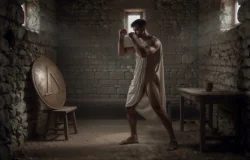
Alkimachos was a hoplite before a battlefield wound ruined his arm and left him a farmer, carrying a second shame on top of it: his brother's public submission in a city where submission is worse than death. When a jealous rival arranges to have his seven-year-old brother conscripted into the Agoge early, to be tormented for the family's 'stain,' Alkimachos has only one way left to clear the name before the boy pays for it. He will fight in the Pankration at Olympia — no rounds, no mercy, no rules but the ones Sparta has already decided apply to him.
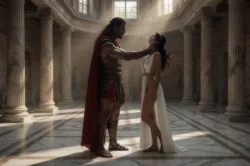
The man standing in his way controls the outcome before Alkimachos ever steps into the ring. Demoleon was passed over for glory once because of this family, and he now holds the assessment that decides whether Alkimachos is even permitted to compete — leverage he uses with sabotage, intimidation, and, eventually, violence. Above them both sits an Admiral guarding Sparta's political prestige ahead of a war with Persia, and beside Alkimachos stands Cynisca, the kingdom's chariot sponsor, whose own reputation and safety are riding on these same Games. Nobody in this story is fighting for only themselves.
What makes the film worth telling isn't the tournament, it's what the tournament is testing: a conviction Alkimachos holds as fiercely as any Spartan — that a man redeems himself only by dying before he submits. The climax is built on that idea literally, an exchange of unguarded strikes in which either man could die to win, and the real victory the film is after isn't the olive crown. It's a man choosing, for the first time, to live — and to love — instead of dying well. It takes the arena of Gladiator and the honor-cult dread of 300 and turns Sparta's own values back on themselves, arguing the one thing the city cannot forgive: that survival is not shameful.
It also doesn't stay narrow. A dying friend's creed becomes the film's refrain. An exiled brother returns to break the sacred Olympic Truce to save him. A mother carries the cost of this honor code in her own voice. By the final match, Alkimachos is fighting for a city, a brother, a woman, and a dead friend's one sentence — and the film has earned every one of them.
Alkimachos is a physical role built on restraint — a former soldier who has to fight a brutal combat sport one-armed while carrying a near-suicidal conviction he must unlearn over the course of the film — and an actor gets both the body of the piece and its entire emotional spine, ending not in martyrdom but in a hard-won, visible choice of life.
Audiences for prestige historical combat dramas — the 300 and Gladiator crowd — who also respond to underdog sports-movie structure and a redemption arc with genuine emotional stakes.
300 · Gladiator · Warrior
This writer knows how to stack stakes -- personal honor, a brother's literal safety, and a king's war plans all ride on the same contest, so every match means more than one thing at once.
The dominance of Sparta's athletes will be a symbol... of how serious and able Sparta is.p.52
In 4th-century BC Sparta, a disgraced, shoulder-shattered veteran defies his city, his dead friend's memory, and a jealous rival to become the first Spartan Pankratiast at Olympia and save his little brother from a lifetime of shame, while a princess risks her neck racing her own chariot in disguise to win Sparta the political triumph its king needs before he can declare war on Persia.
This is a researched, sincerely felt sword-and-sandal underdog story built around a genuinely good compound premise: Alkimachos needs the Olympic crown to erase his brother Praxis's disgrace before his little brother Nikiforos ages into the Agoge and inherits the stain, and that personal quest is entangled with a state-level need for a propaganda victory before Sparta announces war on Persia. Cynisca, drawn from the real first female Olympic champion, gets a clever invented twist -- she secretly drives her own chariot in male disguise -- which gives the story a second, satisfying engine. The combat writing is kinetic and the mythic asides (Milo of Croton, Arrhichion, Endymion) do real tonal work. Set against that: a middle stretch that repeats the same 'let me compete' negotiation three times, an unresolved thread about Alkimachos's Olympic status that is fixed off-page rather than shown, dialogue that frequently stops to brief the audience on history and race rules through characters who'd already know them, and a stated original stake -- Nikiforos's fate in the Agoge -- that the ending never actually answers. The draft also needs a clean proofreading pass; there are merged words throughout and at least one stray fragment of unedited placeholder text left inside a line of dialogue.
Gladiator (2000) · Warrior (2011) · 300 (2007) · Troy (2004)
Adult mainstream audiences for historical action/sports-underdog films, plus history-minded viewers drawn to the ancient-Olympics angle and Cynisca's real-history hook.
The central want is unusually specific for the genre: not generic revenge or glory, but restoring a family name so a seven-year-old brother isn't tormented in military training for a stain that isn't his. That personal stake is then wired directly into a state-level stake -- Sparta needs an uncontested Olympic victory to justify announcing a war of conquest -- so the sport is never just sport. Layering Cynisca's disguised-driver plot on top gives the film a second, complementary engine with its own suspense and its own payoff, and it's grounded in a real historical figure rather than invented from nothing. The combination of family honor, national propaganda, and a woman defying the law to win by her own hand is a genuinely strong hook for a period actioner.
If Niki joins the Agoge now, he's as good as dead.p.10 — concrete, ticking-clock stake, not an abstract 'want to be free'
So I ask you, son of Lakrates. Will you win... like your father... or die trying?p.53 — personal and state stakes explicitly fused by the king
Cynisca, who is pulling a fake beard from her face.p.92 — the invented disguise twist that gives the film a second, satisfying reveal
The story is broadly well-shaped: a battlefield prologue plants the injury and the guilt that pay off in the final round, the beans-and-elimination format of the Pankration tournament is used cleverly to funnel the field back down to exactly Alkimachos and Demoleon, and Nikiforos's sun-in-the-eyes tip lands at the climax exactly because it was set up in a training scene. But the middle act repeats the same beat three times -- Timon says no, Eurybatos duel, then the King's council -- when one or two would do, and a plot thread goes slack: Alkimachos tells Cynisca he has resigned from the Games, and his reinstatement is handled entirely off-page through a cryptic line from a minor character rather than shown. Most importantly, the concrete stake set up on ~page 10 (Nikiforos's fate in the Agoge) is never explicitly resolved -- the ending answers the emotional question (honor restored) but not the practical one the whole quest was built to solve.
I wanted you to know. I resigned earlier from the Games.p.75 — a status change stated and then reversed off-page, creating confusion
You are to re-apply to Ambrosios, the clerk. Immediately, before the Oath.p.84 — the reversal is only implied through a servant's cryptic instruction, not dramatized
The match will be decided by the Climax!p.118 — a genuinely well-earned structural payoff -- an authentic tie-break ritual instead of just another round
Alkimachos has a real, trackable arc from a death-wish opening (he cuts himself absently, his friend jokes he craves a Spartan death) to a closing choice to show mercy rather than kill, and the script bothers to mirror those two moments rather than just stating growth. Cynisca is the best-drawn supporting character -- she has her own ambition, defies the law for it, and gets an ending that is about her merit rather than only her romance. Demoleon gets one real speech of motivation that makes him more than a stock rival, though it arrives very late and isn't built on earlier. The weak spot is the Spartan tournament pack: Brygos, Nicanor, and Laomedon are functionally interchangeable, distinguished mainly by which body part gets broken in which scene, and Ismene largely exists to deliver the film's theme rather than to want something of her own.
Unlike Praxis, I will die before I submit.p.21 — the death-wish stated plainly early
No, you get to live with the shame.p.74 — the mirrored choice showing the arc has actually moved
I've been robbed time and again of everything that should be mine by right. Glory, honor, immortality. Even-- her.p.104 — the one moment Demoleon becomes more than a bully
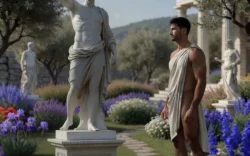
At its best this dialogue has real texture -- the opening banter about the carved statue is characterful and efficient, and the Endymion myth Alkimachos tells Cynisca under the moon is genuinely lovely and does courtship work no exposition scene could. But a large amount of the political and procedural dialogue exists purely to brief the audience: characters tell each other things they would already know, in the exact words a program note would use. The recurring line 'each man should be judged by his own deeds' works as a thematic refrain the first two or three times; by its fifth or sixth repetition it starts to feel like the writer speaking rather than the characters.
As you know, Admiral, due to the high danger of the event, there are no preliminaries in the chariot races, yet I'm rather confident that--p.79 — a driver explaining race rules to a military admiral who runs the mission, purely for the audience's benefit
Because after the Olympic Truce, Agesilaus plans to march on Asia Minor.p.47 — history delivered as a briefing rather than discovered in conflict
Sleep my beloved herder, and I shall caress your blond hair all night and speak to you of love.p.83 — the best writing in the script -- atmospheric, in character, doing romantic work through story rather than statement
The period specificity is a genuine asset -- Milo of Croton's pomegranate, Arrhichion's death-grip championship, the actual mechanics of Olympic bean-draws and the 'Climax' tie-break are details a casual writer wouldn't reach for, and they give the film texture beyond generic toga-and-sandal iconography. Cynisca's disguise is a smart, specific invention on top of real history. But the overall shape -- wounded underdog defies the odds, jealous rival sabotages and cheats, mentor gives one last chance, love interest, brotherly reconciliation, triumphant final embrace -- is assembled from very familiar sports-movie and revenge-movie parts, just relocated to 403 BC. The research elevates the texture more than it changes the shape.
They say he would hold a pomegranate in his fingers and challenge others to take it.p.24 — specific, well-chosen historical texture rarely seen in this genre
Even in death he was again declared the champion.p.102 — the Arrhichion legend used as thematic foreshadowing of the climax
Cynisca, who is pulling a fake beard from her face.p.92 — the one plot mechanic that is genuinely the writer's own invention
The combat prose is the strongest writing on the page -- short, kinetic, visual sentences that a camera could actually shoot. The weaknesses are pacing and cleanliness: the preliminary rounds stack up nearly identical blow-by-blow fights (Brygos, then Nicanor, then Plato) before the final duel, which dulls the impact the final match is supposed to have by sheer repetition. There are also enough merged words and formatting glitches throughout to suggest the draft hasn't had a clean pass -- and one line contains what reads like an accidental keystroke left inside the dialogue itself.
Alkimachos SLAMS a powerful heel-kick into the enemy's metal shield. It CRACKS in half.p.5 — visual, propulsive action writing at its best
What you carving there?fgdfg dg dg gdp.1 — unedited placeholder text left inside a line of dialogue
and by HorkiosZeus see it granted.p.32 — one of several merged-word typos ('Pankrationdisplay,' 'Athenayou,' 'havea') scattered through the draft
Ancient-Greek action epics have a proven theatrical home -- Gladiator, 300, Troy, and the recent Gladiator II revival suggest the appetite is real -- and the female-driver-in-disguise angle gives marketing a genuine hook beyond 'another sword-and-sandal picture.' But this is an expensive premise to realize: massed phalanx battles, a full chariot race with stunt work, and a Temple of Zeus set piece all require real scale, and the story juggles a war-council political subplot, a romance, a tournament, and a family drama that would need careful trimming to pitch cleanly. Without a marquee cast or a director already committed to the genre, this reads as a script that needs a champion rather than one that sells on the page alone.
hundreds of Greek troops in leather battle armorp.3 — scale requirements that push budget upward
the gigantic golden-marble statue of Zeus that looms before the athletesp.85 — a major set piece requiring significant production value
Answer the question the story itself asked on ~page 10: what actually happens to Nikiforos now. The whole quest is framed around protecting him from the Agoge's cruelty, but the ending resolves the emotional register (honor restored) without ever showing whether the practical danger to him is actually gone. Closing that loop -- even in one scene -- would make the triumphant ending feel earned rather than assumed.
Give Nikiforos's Agoge fate an explicit final beat -- show whether he enrolls, and specifically how the restored family name changes his treatment there, even in a single closing scene.
This is the concrete stake the entire quest was built on ('he's as good as dead'); without an answer, the triumphant ending is emotionally satisfying but structurally incomplete.
The ending, ~pages 115-123
Either dramatize Cynisca's intervention getting Alkimachos reinstated in the Games, or cut the 'I resigned' beat entirely if it isn't going to be shown reversing.
As written it reads as a continuity gap rather than an intentional ellipsis.
~Pages 75 and 75
Cut or redistribute the dialogue that briefs the audience on rules and politics through characters who would already know them -- particularly Enops explaining chariot-race rules and Demoleon explaining the King's war plans.
These stall momentum and flatten voice differentiation; the same information can mostly be dramatized instead of stated.
~Pages 47 and 71 especially, and the war-council scene around ~page 60
Compress or cut one or two of the near-identical preliminary-round fights (Brygos, Nicanor) into montage or reaction beats rather than full blow-by-blow sequences.
Four to five nearly identical fight scenes back to back blunt the impact the final Demoleon duel needs to land as the climax.
~Pages 74-98
Give at least one of Demoleon's three henchmen (Brygos, Nicanor, Laomedon) a distinguishing want or beat of his own so the tournament rounds aren't interchangeable.
Currently they're differentiated only by which injury they receive; even a small character touch would make the middle stretch less repetitive.
Gymnasium and preliminary-round scenes throughout
Run a full proofreading pass to fix merged words ('HorkiosZeus,' 'Pankrationdisplay,' 'Athenayou,' 'havea') and remove the stray fragment of unedited text on ~page 1.
These interrupt the read and undercut the seriousness of an otherwise sincere draft.
Throughout
Whether the battle sequences, chariot race, and tournament choreography would actually read as distinct and escalating on screen rather than on the page; how the mythic monologues would land delivered by actors; and what a properly paginated, professionally formatted draft's true length and pacing would feel like, since this text arrived without scene numbering or page breaks.
The 8 main characters and 15 minor characters (on the Minor tab) have been added to this script’s Characters list, with whatever the script gave us about each of them. Open one to change anything or to fill in the rest.
Loading…
Loading…
Loading…
Want to read this script?
Join Script 360 and request it directly from the author!
Write or upload your own Screenplay
Write it, break it down, sketch its characters and get coverage on it — then send a page like this one to anybody you like.
Join Script 360