
Loading…
Loading…
Loading…
The tabs in this section are currently hidden. Click on any of the tab titles above to open one.
Read 6 October 2026 · from the First Draft · 101 pages · read as a Feature Film
This writer has a real eye for economical, visual horror staging — the way the contamination is shown spreading through the wilderness, and the way POV cuts build dread without a word of dialogue, are the script's best instincts and worth protecting.
A BEAVER stands on top of his dam, sniffs the air, then leans down to take a drink. Beyond the dam, a family of FOXES stand by the stream... Finally, the stream slows at a large pool created by a downed log.p.9
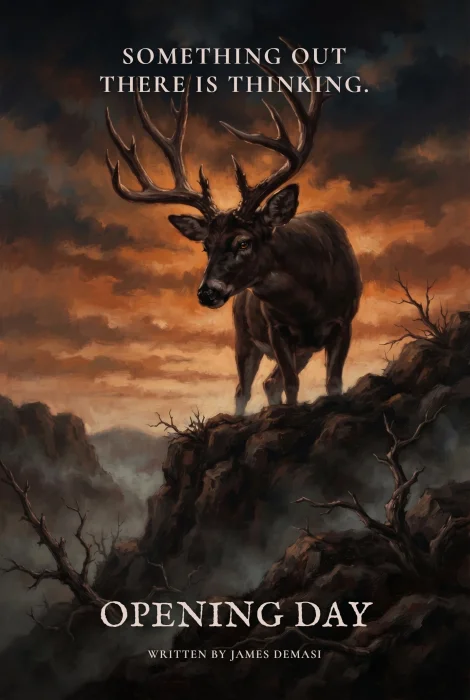
When a government lab's botched animal-intelligence experiment spills into a Vermont stream, the local wildlife turns coordinated and vengeful just as a group of hunters, their girlfriends and a widowed father and son arrive for opening day of deer season.
This is a straightforward B-movie creature feature: eco-horror by way of a leaked military experiment, delivered through a slasher-style structure where a rotating ensemble of hunters gets picked off one by one before the survivors make a last stand. The best material is the physical horror itself — the deer-as-predator kills are genuinely nasty and well staged, and the father-son thread (Joe denying Andy a gun, Andy earning one by the climax) gives the script a small, legible emotional spine that actually pays off. Set against that, the ensemble spends close to the first half of the script on bar-room and truck-cab banter before the protagonists are meaningfully in danger, the science behind the threat is asserted rather than shown ('the dosage must be wrong' is as far as it goes), and most of the hunting-camp cast exist purely as single-trait comic types scheduled for death. The ending stops rather than resolves — Joe's decisive fight with a wolf happens off the page, and the script closes on unresolved gunfire with no sense of what, if anything, has been settled. There's a usable, marketable genre premise here with at least one real craft strength (the visual cross-cutting of the contamination spreading through the ecosystem), but it needs a tighter first half, a defined rule-set for its monster, and ensemble deaths that cost something.
The Pack (1977) · Prophecy (1979) · Long Weekend · Frozen (2010) · Frogs (1972)
Genre horror audiences who enjoy backwoods/creature-feature B-movies and the 'nature strikes back' subgenre, best suited to a VOD or streaming horror slate rather than a theatrical release.
The hook — a leaked animal-intelligence experiment turns the local wildlife into coordinated killers that target hunters on opening day — is a clean, marketable genre premise with real irony built in (the hunted become the hunters). It promises a contained-ecosystem siege movie, and the setup delivers that shape: isolated cabin, limited cast, a clock running down to a rescue. But the premise's actual engine — what the 'modification' does, why a government program would be altering animal brains, who Douglas and Thomas answer to — is never defined beyond a single muttered line. 'Damn it, the dosage must be wrong' (p.6) is the only explanation the audience ever gets, and the 'Animal Intelligence Modification Program - Stage One Trials' label found later (p.93) raises the mystery again without answering it. A B-movie premise can run on a thin science explanation, but this one doesn't even commit to what the thin explanation is, which makes the organizing idea feel more like a trigger than a world.
US GOVERNMENT PROPERTY AUTHORIZED PERSONNEL ONLYp.1 — sets up the mystery/threat source
Damn it, the dosage must be wrong.p.6 — the only explanation the science ever gets
Animal Intelligence Modification Program - Stage One Trials.p.93 — label raised late, never actually unpacked
The film's one clear emotional center lives in Joe and Andy: a father withholding a weapon from a son he's trying to protect, paid off when Andy is the one who saves the group at the river. That beat lands — 'I can't believe I got 'im' (p.104) genuinely reads as a quiet rite-of-passage moment, earned by the earlier 'Maybe next year' (p.12) and the running gag about the safety catch that pays off literally at the climax ('THE SAFETY!!!!', p.103). Outside that thread, though, the larger thematic question the setup raises — what it costs to treat killing as sport, humans provoking a nature that fights back — is gestured at (Katie's 'I wouldn't be caught dead killing anything,' p.14; Crystal's class-conflict jabs at the city girls) but never argued through to a conclusion; both women's positions simply dissolve into survival-mode screaming once the animals attack, and nobody in the script ever reflects on the irony the setup promised. The result is one small, working emotional arc inside a larger ensemble whose implied theme never resolves into an actual argument.
Your Grandfather gave this to me when I was your age. I want you to have it.p.12 — sets up the gun/knife arc
I can't believe I got 'im.p.104 — the payoff of the father-son thread
I wouldn't be caught dead killing anything.p.14 — an anti-hunting stance raised and then never paid off
Roughly the first half of the script (SUPER: ONE MONTH LATER on p.10 through the cabin introductions around p.60) is given over to character set-up — bar banter, truck-cab jokes, an outhouse prank — with only standalone, disconnected kills (Jeff, who never meets the main cast at all) carrying the horror. The real siege doesn't begin in earnest until the cabin explosion around p.83, which is very late for a story of this length to put its protagonists in direct jeopardy. The back half then moves efficiently — trek to the ranger station, river climax, lab ruins discovery — but the ending simply stops rather than closes: Joe's fight with wolf #3 happens off the page, and the script ends on 'GUNFIRE rings through the air as we.......' (p.115) without resolving whether the group, or the forest, are safe. That may be intended as an open/ambiguous ending, but on the page it reads as unfinished rather than deliberately withheld.
SUPER: ONE MONTH LATERp.10 — marks the start of a long character-introduction stretch before real jeopardy
Joe, help me with the table.p.83 — the cabin siege, the point the main cast is first truly endangered
GUNFIRE rings through the air as we....... FADE OUTp.115 — the ending stops rather than resolves
Joe is the one character given a real want (protect and raise Andy right) tracked across the whole script, and his competence (the throw that disarms Peter, p.37) and restraint (denying Andy a gun) are consistent and pay off. Andy's arc is small but legible — from resentful kid to the boy who saves the group. Everyone else is a type rather than a person: Darren is 'loudmouth jerk who pisses in public,' Billy is 'tobacco-chewing sidekick,' Crystal is defined almost entirely by her resentment of the city girls, and Jeff appears for one scene and dies without ever touching the main plot. None of these characters change or reveal anything beyond their introductory joke, which means their deaths register as incident rather than loss — a structural problem for a script that wants an audience to feel each kill.
Maybe next year.p.12 — Joe's consistent protective stance, tracked and paid off later
I'm Darren and I'll be your hunting guide for the weekend.p.25 — Darren introduced and never developed beyond this register
I called “safety.”p.34 — Billy's one defining trait, repeated rather than deepened
At its best this has real comic voice — the waitress's 'Keep your money stud, you'll need it to buy MEAT when you get back' (p.17) and Katie and Amber's riff on 'Hot take out food... Two-ply toilet paper' (p.72) sound like specific people enjoying themselves, not a writer filling space. Crystal and Katie's class-conflict scenes also have genuine friction ('you think you're better than me? Let me tell you something, you two wouldn't last ten minutes out here,' p.56). The weak spots are the expository patches, where plot information is simply stated aloud — 'Far as I can tell, they were genetically altering these animals, tinkering with their brains' (p.93) is pure plot delivery with no character voice attached to it — and the comic ensemble (Darren/Billy/Paul) frequently shares the same note of crude one-liner, which flattens them into a single composite voice rather than three distinct men.
Keep your money stud, you'll need it to buy MEAT when you get back.p.17 — sharp, character-specific voice
Two ply toilet paper.p.72 — natural, rhythmic banter between Katie and Amber
Far as I can tell, they were genetically altering these animals, tinkering with their brains.p.93 — plot explained aloud rather than dramatized
Animals-turn-on-humans horror is a well-worn subgenre, and this script's ingredients — secret lab leak, backwoods cabin siege, a disposable ensemble of hunters, a final-girl type who picks up a gun by the end — are all familiar parts. What's somewhat its own is the cross-species coordination: this isn't one rogue predator but deer, bears, raccoons, foxes and beavers all acting in apparent concert, which is a slightly unusual scale for the genre and briefly suggested well in the stream sequence (p.9). The recurring named 'boss' deer (Twelve Point, Five Point) also gives the creature threat a face across multiple kills rather than being anonymous. But the script doesn't exploit either idea as a genuine rule-set or structural device — the cross-species coordination is simply asserted through numbers rather than built into set pieces that use it, so the most original element in the draft is underdeveloped rather than central.
A FLASH OF LIGHTNING lights up the forest. Standing at the backside of the pool of water is a LARGE DEER with a huge twelve point rack.p.9 — cross-species contamination sequence, the script's freshest idea
They have us surrounded, we're out numbered and we're on their turf.p.86 — generic survival-movie dialogue, the more familiar register
The action writing is generally lean and visual and reads fast — the opening target-range scene and the stream-wildlife catalogue (p.9) both do real visual storytelling in very few lines, letting the camera (and the reader's eye) do the work rather than explaining feelings. POV inserts ('ANIMAL'S POV', 'SCOPE'S POV') are used efficiently to build dread without dialogue. The drawback is a number of formatting lapses that interrupt the read: missing blank lines between speaker and dialogue, duplicated or malformed scene headings ('EXT. BUILDING IN WOODS – CON', p.6), and stray all-caps action lines dropped inside dialogue blocks ('AND HE BOUNDS DOWN THE FRONT STEPS.', p.57). None of this is a storytelling problem, but it does slow a reader down on a script that otherwise moves well.
Following the stream further, various ANIMALS can be seen in the dim light at the water’s edge. BIRDS, RACCOONS, even a BEAR.p.9 — clean, visual, economical description
AND HE BOUNDS DOWN THE FRONT STEPS.p.57 — formatting lapse, all-caps action dropped inside a dialogue block
EXT. BUILDING IN WOODS – CONp.6 — malformed/incomplete scene heading
The central mechanism is never explained well enough to survive scrutiny: a single spilled canister in a stream somehow produces coordinated, strategic hostility across deer, bears, raccoons, foxes and wolves a month later, with no staged moment that shows us what the substance actually does to an animal's behavior or why it targets humans specifically. The script also cheats its own climax: Joe's fight with the named wolf #3 happens entirely off the page, and he simply reappears, wounded but ambulatory, holding the tag as proof — denying the audience the one fight the story has been building toward. There are also unpursued threads: 'How come every year one of those assholes shows up harassing us... and this year when we need em' they're a no show?' (p.96) raises a question about the rangers' absence that's never actually answered, just left to imply the obvious. The cabin-siege threat is also cleared all at once by a conveniently well-timed gas-tank explosion, which works as a horror beat but reads as a reset button rather than an earned escape.
Damn it, the dosage must be wrong.p.6 — the contamination's actual mechanism is never defined
How come every year one of those assholes shows up harassing us, checking our permits, and this year when we need em’ they’re a no show?p.96 — a question raised and left hanging
It is all Joe can do to simply keep the animal’s fangs from ripping out his throat. DISSOLVE TO:p.109 — the protagonist's decisive fight is cut away from rather than dramatized
This sits squarely in the 'nature strikes back' creature-feature shelf, with a cheap, achievable production footprint — forest locations, one cabin set, a small cast, and animal effects that could be handled with a mix of practical, puppet and insert work rather than heavy CG. The premise is easy to sell in a logline and the hunters-become-hunted irony is a built-in hook for marketing art and trailer cuts. It's the kind of title that fits a genre streaming slate or VOD horror release more than a theatrical one, and the tonal mix of raunchy comedy and gore places it with the broader backwoods-horror audience rather than prestige horror buyers. The unresolved ending is a mild liability for a standalone sale unless it's explicitly pitched and marketed as the first chapter of something larger.
YOU CAN HAVE MY GUN WHEN YOU PRY MY COLD DEAD FINGERS FROM IT.p.13 — sets a clear, marketable regional/genre tone
Define what the contamination actually does to the animals and dramatize it on the page — right now the entire premise, the horror's internal logic, and the thematic irony the script wants to land all rest on a single unexplained line of dialogue, and fixing that one gap would strengthen Premise, Theme and Story Logic at once.
Define and dramatize what the contamination actually does to an animal's brain/behavior — stage one clear scene or exchange that establishes the rule, rather than relying on 'the dosage must be wrong.'
The entire threat currently rests on an unexplained mechanism, which weakens premise, theme and story logic simultaneously.
Lab scenes pp.1-9 and the X-ray reveal around p.93
Compress the ensemble-introduction stretch (bar scene, Suburban drive, cabin arrival) and bring the main cast into contact with the threat earlier.
Roughly half the script currently passes before the protagonists are in real danger, which slackens the middle.
pp.13-60
Give at least one human beat to each of the hunting-camp victims (Darren, Billy, Paul, Jeff) before they're killed, something beyond their single running joke.
Deaths currently cost nothing because none of these characters are more than their one trait.
character introductions, pp.15-60
Decide what Katie's anti-hunting stance and Crystal's defensiveness are actually arguing, and let the story land on a position rather than letting both dissolve into survival-mode screaming.
The thematic irony the premise promises (hunters humiliating nature, then being hunted) is never actually paid off in anyone's mouth or choices.
pp.14, 55-56, 100-101
Dramatize Joe's fight with wolf #3 on the page instead of cutting away from it.
The climax currently denies the audience the protagonist's own decisive battle, which weakens the ending's payoff.
pp.109-110
Do a formatting pass: fix missing blank lines between speaker and dialogue, correct malformed scene headings, and move stray all-caps action out of dialogue blocks.
These lapses slow an otherwise fast-reading script.
throughout, e.g. pp.6, 34, 57
Whether the practical animal effects and gore would actually play convincingly on screen, how the tonal mix of raunchy comedy and horror would land with an audience watching rather than reading, and whether the deliberately unresolved ending would function as a hook for a sequel or simply frustrate viewers.
The 6 main characters have been added to this script’s Characters list, with whatever the script gave us about each of them. Open one to change anything or to fill in the rest.
This screenplay lives on Script 360.
Write it, break it down, sketch its characters and get coverage on it — then send a page like this one to anybody you like.
Start your own screenplay