
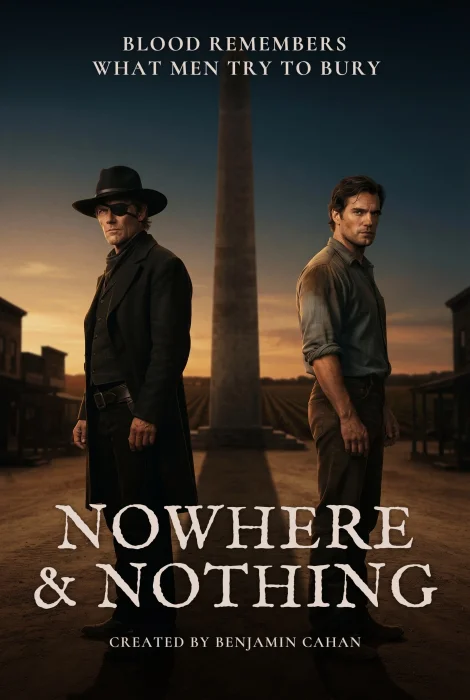
Retired outlaw and gunslinger THOMAS PIKE lives in obscurity on a frontier homestead near the Wild West town of Nusquam with his wife JANE, their feisty 12 year old daughter ANNA, mentally challenged 14 year old son JIM and the family’s household slave, an orange skinned Sprite named NORA.
A frontier town has murdered every lawman sent to civilize it. The next one isn't entirely a man, and the outlaw he's been sent to catch has been living quietly down the road for fourteen years.
Nowhere & Nothing opens on a town called Nusquam that does not reform. It kills the men sent to reform it, quietly and consistently, and has done so for years under the nose of a Lord Mayor who has made peace with the arrangement. Into this walks Zebulon Bodmer: one eye, a temper he can't govern, and a secret buried under an eye patch that the pilot shows us but never explains. He thinks he's hunting the Pike Gang. He doesn't know yet that the gang's leader has a brother — presumed dead for fourteen years, quietly farming just outside town, married, raising a son, and willing to kill without hesitation to keep it that way.
That's the engine: a lawman who has to stop hiding what he is to survive a town built to erase him, and a farmer who has to decide how much of his old violence he's willing to hand down to his children to protect what he's built. Neither man is who the town thinks he is. Both are running out of road at the same time, in the same place, without knowing it yet.
Around them is a frontier soaked in magic nobody quite admits to — enslaved Sprites, a preacher who sermonizes about doom and machinery in the same breath, a Tinker whose loyalties nobody can pin down, a brothel-keeper's ward whose parentage is clearly a loaded gun the show hasn't fired yet. This is a world built to be lived in for seasons, not just an episode — the pilot ends on Bodmer's newborn son tearing away his father's eye patch to reveal a glowing mechanical eye, and answers nothing. That's the promise, not a shortfall: this show knows exactly what it's holding back.
It's a Western with a horror engine underneath it, about what men bury to survive and what that burial costs the people who love them.
Two lead roles built around concealment rather than showmanship — a lawman whose composure is a lid on something inhuman, and a farmer whose gentleness is a disguise for a killer's calm. Both are quiet-until-they're-not parts, the kind that reward restraint over the run of a season.
Viewers who followed Godless and Deadwood for the frontier moral rot and stayed for Westworld's slow-burn mythology — genre-literate audiences who want their Western haunted rather than just hard.
Godless · Deadwood · Wynonna Earp · Westworld
Loading…
Loading…
Loading…
The tabs in this section are currently hidden. Click on any of the tab titles above to open one.
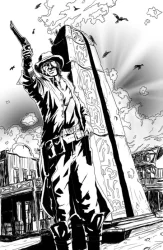
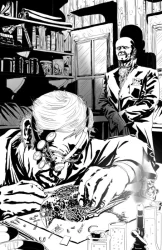
The tabs in this section are currently hidden. Click on any of the tab titles above to open one.
Read 6 September 2026 · from the First draft · 69 pages · read as a 1 Hour Episodic TV The script has been edited since this was written.
The writer has built a genuinely fresh mythological engine — a literal chess-board of fate, prophecy pieces that shake the earth, mechanical hearts grown inside animals — none of which reads as a re-skin of an existing franchise.
The Tinker places the Mini Cog Heart inside the crow's chest next to its beating heart. -- The Mini Cog Heart's clear shell dissolves as it sinks into the crow.p.58
A one-eyed lawman with a mechanical secret arrives in a corrupt frontier town built on the buried ruins of a lost civilization to hunt down an outlaw gang, not knowing that the gang's supposedly-dead founder is alive, raising a family, and watching him from a nearby farm.
This is an ambitious genre hybrid — Deadwood-style frontier corruption crossed with a magic/steampunk mythology (a mysterious Tinker manipulating a literal chess-piece prophecy, a slave race called Sprites, cog-hearted crows, a hero whose eye turns out to be machine, not flesh) — and the mash-up itself is the script's real asset. The pilot economically plants two mirror-image heroes, a lawman who is secretly not fully human and an outlaw legend who is secretly not dead, and ends on a clean mystery-box hook. Where it struggles is focus: the ensemble sprawls across a dozen named characters and several one-scene subplots (the mining bosses, the Goodnight brothers) that never connect back to the engine, the protagonist's motivation is largely handed to him by an off-page patron rather than owned by him, and at least two recurring plot threads involving minors (Anna and the drifter Lizard; Judah and Bella) are written in a seductive register whose intent is unclear on the page. The mythology is genuinely inventive and the act-break cliffhangers mostly land, but the middle needs trimming and the tone needs a firmer hand before this is ready to go out.
Deadwood · Westworld · Godless · His Dark Materials · Wynonna Earp
Adult viewers of prestige/genre streaming drama who want a Western with a supernatural or steampunk mythology underneath it — not a broadcast-network audience given the content level.
The central promise — a one-eyed marshal sent to clean up a lawless frontier town discovers the legendary outlaw he's hunting is alive and hidden, while concealing that he himself isn't entirely human — is a strong, specific engine for a season, not a vague 'good guy vs bad town' setup. The pilot commits to that promise concretely: Bodmer states his mission in plain terms ('I've come to put an end to the Pike Gang', p.6) and the final page delivers on the character-level mystery it's been sitting on since the teaser. The weakness is that Bodmer's stake in his own mission is borrowed rather than earned — he is fulfilling an assignment from an off-page 'Lord Governor' and a debt to the Tinker, which makes the premise's engine feel imposed on him rather than driven by him. Still, the world itself (an obelisk-town, a magic-caste system, a slave race with collars) gives the premise scale and texture beyond a standard revenge-Western, and the reveal that the legend is alive on a nearby farm is a genuinely good pilot-ending idea.
I've come to put an end to the Pike Gang.p.6 — states the season's driving mission plainly
There is this thing inside of me and sometimes I can't control it.p.20 — plants the character-level mystery the pilot is organized around
Behind it hides a METAL EYE. It stares at us, a slight RED GLOW where the pupil should be.p.59 — delivers on the mystery as the closing hook
The pilot uses the classic Teaser/Act One-Four broadcast shape and each act break is built to end on a hook — Anna's scream ('He's coming', p.25), the bath-scene cliffhanger with Lizard ('then another and another...', p.37), Skye's scream at the eye patch (p.49). That's disciplined episodic craft. The trouble is the middle: Act One in particular stacks a great many scene-setting beats back to back (arrival, obelisk, Tinker glimpse, dinner-party lore dump, swearing-in ceremony) before the story proper gets moving, and momentum sags under the exposition. The Act Three cliffhanger is also a bit of a bait-and-switch — Skye's scream at seeing the eye is immediately reassigned to her water breaking in Act Four, which deflates the moment it just built rather than paying it off, and the real answer is deferred two more acts to the final page. The mid-episode turn where the Tinker reveals Thomas Pike is alive ('No, he's in hiding', p.46) is the pilot's real structural spine and lands well, recontextualizing everything on the Pike farm.
Anna wakes up with a SCREAM. Lightning flashes outside her window.p.25 — Act One button
Anna takes a nervous step towards the tub, then another and another...p.37 — Act Two button, an effective threat cliffhanger
No, he's in hiding.p.46 — the pivot that reframes the entire B-plot
Bodmer has a stated, concrete want ('I need your help... I can't return home 'til he's dead', p.46), but it's granted to him by others rather than chosen, and paired with a passivity in his own scenes — he mostly reacts, broods, and stares at his drink rather than driving action, which risks a flat lead for a pilot audience meeting him for the first time. Thomas Pike is the more interesting figure: a legendary killer hiding behind a folksy front, whose stated moral code ('Kill with love my child, never out of fear or hate', p.9) is directly and coldly violated when he executes Lizard in the woods ('He SHOOTS Lizard in the face', p.55) — that contradiction is a genuinely good character beat, though the script doesn't call attention to it as one. Anna's arc is the most troubling: her sibling jealousy is clear, but her scenes with Lizard ('Do doves like to be eaten?', p.53) are written in a seduction register whose intent — is she in danger, is she complicit, is this meant to read as horror — is not legible on the page for a thirteen-year-old character. The supporting cast is large and several members (the Goodnight brothers, Mark and Colin the mining bosses) exist for a single scene each with no bearing on the ongoing plot.
I need your help. I was sent here to bring an end to the escapades of James Pike and his gang. I can't return home 'til he's dead.p.46 — Bodmer's want, but framed as obligation rather than desire
Do doves like to be eaten?p.53 — tonal ambiguity around a minor character in danger
Thomas puts a hand over his heart. We hear his heart beating, slow and steady. He SHOOTS Lizard in the face.p.55 — a real, under-flagged contradiction in the character's stated code
At its best the dialogue has real weight and a period register that earns its emotion, particularly Owen's death: 'We were brave enough, weren't we, sir?' followed by a salute (p.6) — that's a genuinely affecting scene built almost entirely on dialogue rhythm. Elsewhere the writer reaches for a mythic, aphoristic register ('Kill with love my child, never out of fear or hate', p.9) that mostly works for Thomas's voice. But a good deal of the dialogue is doing exposition's job rather than character's — the dinner-party scene has Ashley deliver world lore almost as a checklist ('My great grand daddy was a magus. Of the second order.', p.22) — and some emotional beats are stated outright rather than dramatized, as with Bodmer's speech to Skye ('you were the only one perfectly formed', p.20), which tells us the theme instead of letting the scene earn it.
We were brave enough, weren't we, sir?p.6 — best dialogue in the script, earns its emotion
My great grand daddy was a magus. Of the second order.p.22 — lore delivered as exposition rather than character speech
You don't have one bad ingredient, out of all the creatures on earth, you were the only one perfectly formed.p.20 — theme stated rather than dramatized
This is the script's clearest strength. Rather than dressing a standard Western in fantasy trim, the writer has built a mythology with its own internal logic: a Tinker who literalizes fate as chess pieces that make the earth shake when placed ('The North Wind, the first piece on the board', p.14), a slave race (Sprites) with collar-bound magic, and mechanical 'cog hearts' grown inside animals as instruments of some larger design ('Tiny beautifully constructed gears slither around inside it, creating orbits within orbits', p.58). None of these individual devices reads as a lift from an obvious source, and the specific image of a monolithic buried obelisk that towns are built around unthinkingly is a strong, resonant piece of world-design. Where the script leans on more familiar material is at the character-arc level — the hidden gunslinger farmer, the corrupt brothel-owner who sits on the town council, the frontier marshal ceremony — these are stock Western furniture, competently assembled rather than reinvented. The gap between the highly original mythology and the fairly conventional character arcs sitting inside it is worth the writer's attention.
The North Wind, the first piece on the board.p.14 — fate literalized as a game, a genuinely fresh device
a metal collar covered in strange symbols encircling her neckp.5 — a distinctive world detail (the Sprite race) that is still under-explained
shiny Maker Ants. The Maker Ants are metal little creatures. They crawl down Lizard's throat.p.56 — an unexplained but striking mythological image, planting mystery for later episodes
The opening page is genuinely strong, visual writing: 'Four long, slender hoofed legs move cautiously through a heavily wooded and leaf strewn forest' (p.1) trusts the camera. But elsewhere the description tips into telling rather than showing — 'his rugged clothing, steely gaze, weathered face and cold blue eyes tell a tale of a hard life' (p.2) is a character bio, not a shot. The bigger craft problem is tonal control: the script cuts directly from Sampson's execution ('the back of Samson's head EXPLODES in blood and gore!', p.51) into a comic sex scene played for laughs ('Sunshine moans her pleasure quite unconvincingly'), and that whiplash undercuts both moments rather than building a deliberate dark-comic rhythm. There's also some inconsistency worth a clean-up pass — the character is introduced as 'Sampson' but is spelled 'Samson' in places, and 'William' becomes 'Williams' mid-scene — not score-moving on their own, but signs of a draft that hasn't had a final line-edit. Several scenes (the Goodnight brothers' Dora harassment, the mining-boss vignette) exist as color without feeding forward into the plot and are the first candidates for a trim.
Four long, slender hoofed legs move cautiously through a heavily wooded and leaf strewn forest.p.1 — strong, visual, camera-ready opening
his rugged clothing, steely gaze, weathered face and cold blue eyes tell a tale of a hard lifep.2 — novelistic telling rather than visual description
the back of Samson's head EXPLODES in blood and gore!p.51 — immediately followed by a comic sex scene, a tonal collision
This is premium-cable or streamer material, not broadcast — the explicit brothel content, graphic violence, and the uneasy material involving minors would need a network with genre appetite and a mature-content rating (comparable to what carried Deadwood or Westworld). The mythology gives it a hook that could differentiate it in a crowded Western-adjacent slate, and the mystery-box ending is a reasonable pilot-to-series pitch. Against that: the large ensemble and heavy world-building make this an expensive pilot to produce (period Western production values plus practical/VFX for the magic and mechanical elements), and the content involving Anna and Bella will draw serious scrutiny from any standards-and-practices read before it draws praise for ambition. It's a script with real identity, which matters more than polish at the buyer stage, but it's not an easy sell as written.
There was a dream that was New Idmon. It is nothing more than a whisper now.p.33 — the mythic register this would need to sustain a premium-drama pitch
Sunshine dutifully drinks from the cup, swishes it around in her mouth and spits out the liquor into the night panp.16 — content level signals mature-audience platform only
Give Bodmer a want of his own before anything else gets fixed — right now the central mystery-box (his mechanical eye) is the most active thing about him, and everything else he does is on someone else's orders. Structural and content fixes elsewhere will land better once the lead is driving rather than being driven.
Give Bodmer a want that is his own rather than assigned by the Lord Governor or the Tinker — something personal he's protecting or chasing that the Pike hunt threatens or serves.
as written, his mission is a favor owed to an off-page authority, which keeps him reactive through his own pilot
the Tinker/obelisk scene (p.46) and the earlier dinner scenes
Decide, deliberately, what the Anna/Lizard and Judah/Bella dynamics are meant to communicate, and rewrite the dialogue register so the intended read (danger, grooming, complicity, etc.) is legible on the page rather than ambiguous.
as currently written these scenes could be read as titillating rather than critical, which is a serious risk for any buyer
the outhouse scene (p.53), the bath scene (p.37), the Judah/Bella picnic scene (p.44)
Cut or fold in the subplots that don't feed the ongoing engine — the Goodnight brothers' harassment of Dora, the mining-boss vignette — and use the freed space to slow down and clarify the Bodmer/Thomas Pike parallel.
trims an overstuffed middle and sharpens focus on the two leads
Goodnight brothers scenes (p.35, p.47), Mark/Colin scene (p.31)
Reconsider the Act Three cliffhanger — either let Skye's reaction to the eye patch actually be about the eye in that moment, or restructure so the deflation into labor pains doesn't read as a bait-and-switch.
currently the strongest visual hook of the middle acts is undercut a page later
p.49-50
Do a tone pass on scenes that cross-cut comedy and violence (Sampson's death against the Doc Sibley/Sunshine scene) to decide if the tonal collision is intentional dark comedy or an accident of pacing.
as written it reads as a mismatch rather than a choice
p.51-52
Find non-dialogue ways to deliver Silver City / magus / Sprite lore currently dumped in the dinner scene — visual world-building, action, or shorter, more oblique references.
currently the scene stops the story to explain the world
Lord Mayor's dinner scene, p.14-16
Whether the tonal collisions (comedy against violence, the ambiguous material involving minors) play differently under a director and actors than they read on the page; whether the magic/mechanical VFX would be convincing or affordable at the scale implied; and how the large ensemble would resolve across a full season, which this pilot alone can't answer.
The 8 main characters and 24 minor characters (on the Minor tab) have been added to this script’s Characters list, with whatever the script gave us about each of them. Open one to change anything or to fill in the rest.
This screenplay lives on Script 360.
Write it, break it down, sketch its characters and get coverage on it — then send a page like this one to anybody you like.
Start your own screenplay