
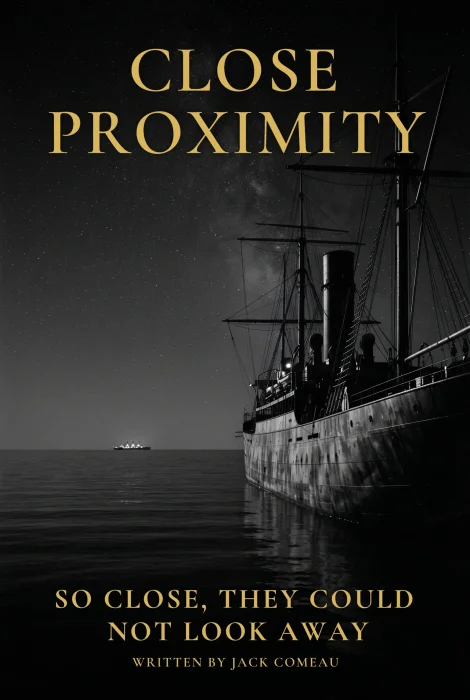
CAPTAIN LORD is a self-made merchant officer who has built his career on discipline and restraint, and who wants nothing more from this crossing than to finish it without incident and hand his son a name worth having. On a clear, ice-choked night, his ship the Californian stops for safety, and her officers spot an unidentified vessel firing white rockets in the distance. Told they may be signals of distress, Lord decides they are not, and goes back to sleep without waking his wireless operator. Less than twenty miles away, Titanic is sinking.
By morning the Californian steams into a field of wreckage and frozen bodies, one resembling Lord's own son. Rather than search, he denies to his own ship that any bodies were seen at all, and orders a course set for Boston. Among his junior officers is THIRD OFFICER GROVES, a man who watched the rockets that night without understanding what he was seeing, and who wants only to bank one last voyage's pay and leave the sea for a family of his own. As rumor turns to inquiry, the crew makes a private pact to stand as one and say nothing that contradicts the captain's account.
A U.S. Senate investigation opens under SENATOR SMITH, initially consumed by the disgrace of Ismay, the White Star Line president who survived the sinking. The Californian is a footnote until STOKER ERNEST GILL, unable to carry the crew's silence any longer, sells his account of the rockets to the Boston American. The story returns to the front pages, and Smith's attention turns to Lord's ship. The case seems to stall until a hydrographic scientist, MR. KNAPP, proves that the two ships' clocks were mismatched by twelve minutes; corrected, every rocket sighting lines up exactly with Titanic's distress signals. The inquiry reopens, this time aimed squarely at Lord.
On the stand, Groves breaks from the agreed story and confesses everything he saw that night and failed, at the time, to understand. Separately confronted with his ship's altered log, Lord cannot bring himself to read aloud the words that were struck from it. The British inquiry formally finds against him; the Leyland Line forces his resignation. His son is beaten at school for his father's cowardice. In the film's final scene, Lord sits broken in his own kitchen and tells the boy, for the first time, that feelings are not meant to be controlled, while his wife, BEATRICE, holds him through the collapse. The truth Lord spent a lifetime containing costs him his career, his reputation, and finally the composure he mistook for strength — and leaves him, at the end, undone but honest.
The ship closest to the Titanic never moved to help her — and the captain who kept her still spent the rest of his life insisting that was the reasonable thing to do.
Close Proximity is not a disaster movie. The sinking happens off-page, twenty miles away, glimpsed only as rockets in the dark and bodies in the ice the next morning. What the film is actually about is what a reasonable man tells himself in the hours and years after he chooses not to act — and what it costs him to keep believing it.
Captain Stanley Lord is a self-made man who has built his whole identity on control: of his ship, his crew, his emotions, and the legacy he means to leave his son. When his officers report distress rockets from an unidentified vessel, he does the controlled thing — he goes back to sleep. By morning the Titanic is gone, and Lord's next decision, to deny ever seeing the bodies in the wreckage field, sets the rest of the film in motion. Opposite him is Third Officer Groves, a younger man who wants nothing more than one last paycheck and a way off the sea for good, and who learns that silence has a price too.
The engine of the back half is a Senate inquiry that functions less like a trial and more like a slow-motion autopsy of a man's conscience — ship's logs, mismatched clocks, a stoker who can't live with the crew's pact of silence, and finally a courtroom confession that breaks the story open from the inside. There is no villain here in the usual sense, just the steady, procedural pressure of the truth refusing to stay buried.
This is a film for an actor who wants to play denial from the inside — not as melodrama, but as a kind of discipline that curdles into cowardice in real time, and then finally cracks. It ends not with a verdict but with a man on his kitchen floor, finally saying the thing his whole life was built to avoid saying.
Captain Lord is a role built on restraint that fails him in slow motion — a man whose entire self-image depends on never showing feeling, written to collapse publicly and privately over two hours. Groves offers the mirror part: the quieter complicity of a man who knew better and said nothing until the stand forces it out of him.
Audiences for procedural moral dramas built on real inquiries and real men under oath — the A Night to Remember and The Insider crowd, and awards-season viewers drawn to a true story told from its most uncomfortable angle.
A Night to Remember · The Insider · Judgment at Nuremberg
Read 17 September 2026 · from the First Draft · 107 pages · read as a Feature Film The script has been edited since this was written.
This writer can build a protagonist whose stated philosophy and his suppressed trauma are actively at war with each other, so that his contradictions are the story rather than a flaw in it.
I'd gladly travel the road to hell in order to stay a hero in his eyes.p.68
When the crew of a nearby tramp steamer mistakes Titanic's distress rockets for company signals and does nothing, its captain's rigid cult of self-control unravels under a US Senate inquiry, a subordinate's guilty confession, and his own long-buried trauma.
This is Titanic told from the ship that didn't come — the Californian, whose officers watched rockets go up on the horizon and went back to bed. That's a genuinely underused angle on overfamiliar material, and the script commits to it fully: almost the whole runtime is spent on Captain Stanley Lord's psychology, his crew's paralysis, and the Senate/House of Commons machinery that eventually exposes him. The strongest material is specific and physical — the arcade shooting-gallery scene where Lord's pride costs him the prize his son wants, the body-recovery sequence among the ice, Groves' confession being met with contemptuous dismissal instead of the absolution he's begging for. The weakest material is verbal: Lord and others frequently say the theme out loud ('Mind over emotion,' 'Restraint is a virtue') rather than letting the audience find it, and a long stretch of near-identical Senate hearing scenes (Ismay, Bride, Fleet, Lightoller, Boxhall, Stone, Lord) risks becoming a parade rather than a rising line. A couple of supporting threads — Groves' wife Janie, stoker Ernest Gill's class-conscious mutiny talk — are set up with real specificity and then simply dropped. What's here is a script with a real idea and a real protagonist, hobbled by a tendency to explain itself and a back third that keeps restating its climax after it's already landed.
A Night to Remember · Frost/Nixon · Denial · The Crucible · Chernobyl (limited series)
Adults drawn to prestige historical and courtroom drama — awards-season arthouse audiences and Titanic history enthusiasts looking for the story's moral margins rather than its spectacle.
Dramatizing Titanic through the ship that saw the rockets and didn't move is a strong choice — it turns a familiar disaster into a story about denial and complicity, which is fresher and cheaper to film than another iceberg spectacle. The opening act does the work of establishing why this matters (Lord's obsession with control, the crew's fear of waking him) before the disaster even happens, so the premise isn't just a historical footnote, it's set up as the engine of the story. The script also understands the built-in irony of its premise and returns to it directly: Smith's closing indictment states the stakes plainly. Where the premise strains a little is in how much of the second half is spent proving the same point (that Lord saw the rockets and lied) across multiple redundant scenes, which suggests the writer trusts the premise itself more than they trust the audience to have gotten it the first time.
Sir, that ship, she fired three more rockets and then disappeared.p.29 — the crux of the premise: the moment the crew has the information and does nothing
If Californian had responded to the rockets, many, possibly all of the lives lost, could have been saved.p.100 — the premise's stakes stated by the antagonist figure
We've seen no bodies.p.36 — the first act of the cover-up, planted immediately after the discovery scene
The emotional core lives in Lord: a man who has built an entire identity, and a whole philosophy for raising his son, around the idea that feeling is weakness — and who is destroyed precisely because that philosophy kept him from acting the one night it mattered. The scene where it should land hardest is the final kitchen scene with Bea, and it does land, but it lands because the script tells us it has, via Lord's own summary of the lesson rather than through an action we've watched him take. What the film is arguing — that suppressing emotion in the name of discipline is itself a kind of moral failure — is a real argument, and it's dramatized well in places (the shooting gallery, the schooner backstory), but it's also stated aloud so often ('Mind over emotion, remember that') that by the ending the audience has already heard the thesis several times before the wife delivers its final, tidiest version. The ghost sequence in the church is the boldest attempt to stage the theme rather than state it, and it's the closest the script comes to earning the feeling rather than announcing it.
Mind over emotion.p.14 — the theme stated directly and repeated almost verbatim later
The only true power we have over our emotions is the courage to feel them.p.105 — the closing thesis delivered as a line rather than dramatized
Restraint is a virtue. A young man must be the master of his feelings.p.15 — theme introduced through direct instruction to his son rather than behavior
The backbone is sound and historically anchored: setup on the Californian and with Lord's family, the sighting and the disaster, the cover-up forming in Boston, the Senate hearings building toward Groves' confession and Lord's public unraveling, then a coda of consequences. The trouble is the middle third, which is structured as a sequence of near-identical hearing scenes — witness called, questioned, dismissed, next witness — that mostly repeat the same discovery (the mystery ship, the rockets, the discrepancy in the log) rather than escalating it scene to scene. Groves' confession and Lord's log-book grilling arrive close together as two separate climaxes rather than one sustained one, and then the story keeps going for several more scenes (House of Commons, resignation, the schoolyard beating, the kitchen reconciliation), which dilutes the momentum the confession scene earns. The strongest structural device in the script is the parallel drift between Groves' guilt (which resolves in public humiliation rather than relief) and Lord's guilt (which resolves in private breakdown), and that parallel would land harder with the hearing scenes trimmed to make room for it.
I recall to the stand, Californian's Captain Stanley Lord.p.89 — one of several nearly identical 'called to the stand' transitions
I saw ROCKETS! Not flares or Roman candles. Rockets. God forgive us.p.86 — the first climax
Your log is not the act of a man unaware of wrongdoing. It is a deliberate attempt to conceal the truthp.94 — the second, separate climax a few pages later
Lord is a genuinely specific, contradictory protagonist: a self-made man who despises the class he came from, worships facts and discipline, and is unknowingly still the traumatized boy who was handed a rifle on a schooner as a teenager. His want is concrete and consistent — protect his career and remain a hero in his son's eyes — and it's the exact thing that keeps him from telling the truth, which is a clean, well-built engine for a character. Groves is nearly as good: a man who wants shore work and a family, who is destroyed by his own inaction, and whose eventual confession is denied the catharsis he's clearly hoping for, which is a genuinely bold and mature character choice. Where the script is thinner is the women — Bea exists almost entirely to receive Lord's breakdown at the end, and Janie is set up with a real want ('I want children... A job at home? No more shipping out?') and then vanishes from the story entirely. Stone and Gibson are functional rather than distinct from each other. But the two men the film is actually about are drawn with real psychological texture, and Lord's final scene, however over-explained verbally, is earned by everything we've watched him do and fail to do across the script.
I'd gladly travel the road to hell in order to stay a hero in his eyes.p.68 — Lord's concrete, specific want stated plainly
I'd rather suffer taunting that I don't deserve than escape that which I do.p.82 — Groves' competing want, in direct conflict with Stone's
God punishes pridefulness.p.17 — Lord's control obsession dramatized physically in the shooting gallery, not just spoken
There's a real ear here in the early ship-board scenes — Stone and Groves' banter about home and sea, the German steamer gag, the shorthand between officers — that sounds like people who work together rather than a writer relaying plot. Lord's public dialogue in the hearings is also sharp, especially his evasions under questioning ('Company signals could be white'). But a large amount of Lord's private dialogue is essayistic rather than conversational — he delivers finished theses about virtue and emotion to Stewart, to Bea, to his son, in nearly the same cadence each time, which flattens him into a mouthpiece in those scenes even though he's vivid everywhere else. The low point is Groves' scene with the prostitute, where grief comes out as philosophy rather than as a broken man talking: a genuinely strange choice that undercuts what should be his most vulnerable scene. The high point is small and unforced — a single line of gallows wit that tells you everything about these men's relationship to the sea without explaining anything.
Closest English translation would be...Bugger off, you Krauts.p.5 — best dialogue: character voice, humor, no explanation needed
Truth is not a buffet table of facts to choose from. Truth is singular by its very nature.p.48 — worst dialogue: an essay delivered to a stranger in a brothel instead of a broken man talking
Once you learn facts, you can free yourself of silly superstitions. Always remember, mind over emotion.p.14 — a recurring pattern of Lord as thesis-deliverer rather than conversationalist
The choice of protagonist and vantage point is the script's real invention — nobody picks up a Titanic story to spend it entirely with the ship that failed to respond, and that choice reframes a story everyone thinks they know as a study of complicity and denial instead of spectacle. The church sequence, where the fishermen Lord shot as a boy appear singing among the congregation alongside Titanic's drowned band, is a genuine formal swing — a hallucinatory intrusion into an otherwise straight docudrama register — and it's the boldest thing in the script, whether or not it ultimately belongs tonally with everything around it. Set against that, a lot of the machinery is familiar: the crusading senator with a flip chart, the disgraced man's wife who takes him back at the end, the loyal manservant-confidant who asks the questions the audience is asking. The script knows its angle is its best asset — it never once cuts away to Titanic's deck for spectacle's sake in the first two acts — but it doesn't always trust that angle to carry scenes on its own, reaching for stock courtroom-drama beats to do work the original premise could do itself.
There, standing and singing with the group, are the three fisherman who Lord shot as a boy on the schooner.p.90 — the boldest, most original formal choice in the script
How do you explain that ship, Sir?p.13 — an early, genuinely inventive use of Saint Elmo's fire to dramatize the science/superstition theme visually
We call Titanic's surviving wireless operator, Harold Bride.p.47 — the courtroom-drama scaffolding is familiar and repeated with several witnesses in the same rhythm
The prose moves well in the ship-board and disaster sequences — short, visual, economical lines that put a reader on the deck without slowing them down. The body-recovery sequence is the strongest writing in the script: specific, restrained, and devastating without straining for the effect. Elsewhere the writing reaches past what a camera can show into pure interiority — 'Something snaps inside Lord. Something dies, replaced by demons we can only guess at' is a note to an actor and director more than a filmable image, and there are a number of these across the script (‘Pressure builds on Lord's face. His muscles tighten like springs’). The script also has a handful of formatting slips that would briefly confuse a reader following who's speaking — a mid-hearing exchange attributes a line to a mashed-together 'IRISHMAN SMITH' cue, and a Capitol-steps exchange attributes the lawyer's question to 'SMITH' — plus small spelling errors ('flairs' for flares, 'NEWSPAER'). None of this is a large problem on its own, but it should get a clean pass before this goes out.
A tramp steamer plows through the dark waves. She sports a single, soot-smudged funnel, amidships.p.1 — clean, visual opening description
A small dead girl drifts by, still clutching her stuffed doll. Ice has formed around her eyelids.p.34 — the script's strongest, most restrained writing
Something snaps inside Lord. Something dies, replaced by demons we can only guess at.p.34 — an unfilmable interior-state note rather than an action a camera can capture
The plot machinery mostly holds together and tracks the historical record closely, which gives the cover-up and its unraveling real internal consistency — Lord's altered log, the twelve-minute clock discrepancy, the drift calculation are all set up and paid off cleanly by the Hydrographic Office testimony. Where it loosens is in threads introduced with real specificity and then abandoned: Janie is given a clear want in her one scene ('I want children... A job at home?') and is never seen or mentioned again after Groves invokes her name once in a brothel; Ernest Gill is set up as a class-conscious counterweight to the officers, threatens to go public, actually does, and then simply disappears from the story with no scene showing the cost or consequence to him personally. Groves' own fate — shoveling coal in the final act — is implied rather than explained, which works as a show-don't-tell choice but risks leaving a reader unsure exactly what happened to his commission. These aren't structural contradictions so much as unfinished business the writer clearly knows about (both characters are given real voices early on) but doesn't circle back to close.
I want children.p.20 — Janie's want, established and never revisited or resolved
In the corner, Ernest Gill watches with contempt.p.44 — Gill positioned as a recurring conscience figure who is then dropped after his statement
Groves pauses to stretch out his aching back... there is a curious contentment on his face.p.108 — Groves' fallen circumstances shown but never explicitly connected to a consequence for confessing
This is a mid-to-large-budget period piece — ship exteriors, Boston/New York/Washington sets circa 1912, a limited but visceral sinking sequence — dressed as a psychological and procedural drama rather than a disaster film, which is both its best selling point and its hardest one. It offers a genuinely strong showcase role for a character actor (Lord) and several good supporting parts (Groves, Smith, Lightoller), which is the kind of package that attracts awards-conscious casting, and its Titanic adjacency gives it built-in audience awareness without needing the full disaster budget. Against that, the courtroom-hearing-heavy middle section and total absence of the spectacle mainstream audiences associate with the Titanic story make this a tough theatrical pitch outside prestige distributors, and it may in fact be better suited to a limited series format than a single feature, given how episodic the hearing structure already is. As a feature spec, this reads as a specialty/awards play rather than a wide commercial release.
The Statue of Liberty strobes through lightning bursts. In the flicker, she looks more menacing than welcoming.p.43 — one of the few moments of real visual scale/spectacle in the script
We call Titanic's surviving wireless operator, Harold Bride.p.47 — the procedural, hearing-driven structure that marks this as a specialty rather than mainstream picture
Trim the hearing-scene midsection so it escalates instead of repeats, and let that reclaimed space go toward dramatizing Lord's philosophy through action rather than restating it in speeches — the script already has the tools to do both (the shooting gallery, Groves' confession) and needs to trust them more than it currently does.
Cut or combine several of the near-identical Senate hearing witnesses (Ismay, Bride, Fleet, Lightoller, Boxhall, Stone) so each surviving scene reveals something the last one didn't, rather than restating the mystery-ship discrepancy.
the middle act currently repeats its own discovery multiple times instead of escalating, which softens the two climaxes (Groves' confession, Lord's log grilling) that follow it
pp. 38-83
Pull back Lord's explicit theme-speeches ('mind over emotion,' 'restraint is a virtue') and let at least two of them play out as behavior instead — a choice he makes rather than a lecture he gives.
the theme is currently stated so often in dialogue that the ending's version of the same idea has no surprise left in it
family scenes, pp. 14-19
Either bring Janie back for one more scene that pays off her stated want, or trim her introduction scene if she's not going to be revisited; do the same for Ernest Gill's fate after he goes public.
both characters are set up with real specificity and then abandoned, which reads as unfinished rather than intentional
p. 20 (Janie), pp. 44-58 (Gill)
Rework the closing kitchen scene so the reconciliation between Lord and Bea is carried by an action rather than by Lord's final summarizing line about emotion and courage.
the ending currently states the film's thesis outright instead of trusting the embrace to say it
final scene, pp. 104-105
Do a formatting pass to fix mislabeled or merged dialogue cues and a few spelling slips.
these momentarily confuse who is speaking and would read as sloppy to a buyer
p. 55 (mixed IRISHMAN/SMITH cue), p. 62 (SMITH attributed to the lawyer's line), 'flairs' for flares, 'NEWSPAER'
Whether the church hallucination sequence would play as a bold formal risk or a tonal misstep depends entirely on direction and cutting, which can't be assessed from the page. Whether Lord's monologue-heavy scenes land as tragic or stagy will depend heavily on casting. And whether this works better as a feature or a limited series — given how episodic its hearing structure already is — is a packaging question the pages alone can't answer.
Loading…
Loading…
Loading…
This screenplay lives on Script 360.
Write it, break it down, sketch its characters and get coverage on it — then send a page like this one to anybody you like.
Start your own screenplay