
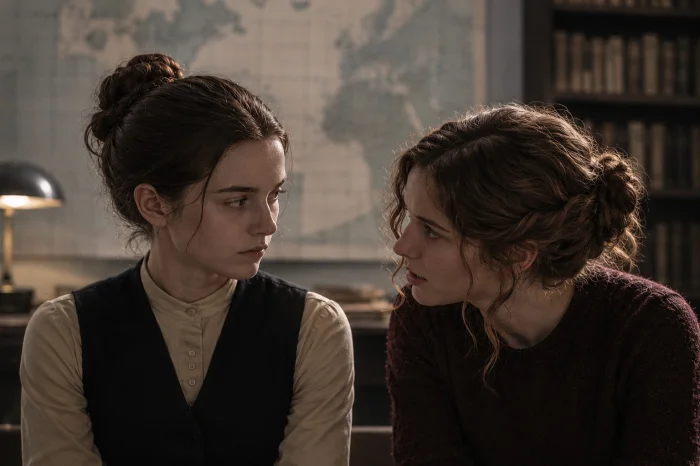
Very low budget. Only a few locations. Mostly people talking.
This writer's gift is finding a genuinely new way to put a psychological state on the page — not as a twist to be revealed, but as a visible, continuous fact of the story from the start.
Anya is gone. Emma has taken her place.p.6
A severely withdrawn young research assistant and the confident, seductive, increasingly destructive persona who takes her place whenever she can't cope trade control of her body and her life until the people around them start paying the price.
This is a dense, literary two-hander built on a single bold device: Anya, a traumatized, anxiety-paralyzed young woman, is periodically and visibly replaced in scenes by 'Emma,' a confident, cruel, seductive alter who speaks for her, flirts for her, manipulates for her, and eventually destroys people on her behalf. The stage directions do the explaining rather than any dialogue ('Anya is gone. Emma has taken her place,' p.6), which is a genuinely unusual and often effective way to dramatize dissociation on the page. The script is strongest in its two central performances-on-paper: the restroom mirror scene (p.29-30) and the hospital reunion (p.79-80) are both quietly devastating. Its weaknesses are structural and logical rather than stylistic: the back half strands several subplots (Rick, Mick, Tabby, the Trey assault) without resolution, and the Emma/Anya device, clean and legible early on, becomes ontologically confusing once Emma starts registering at hospital reception and giving police statements as an independent person. The final pages shift from screenplay into dense interior prose-poetry that is hard to stage. This reads like a genuinely original, difficult, art-house character study that would need a tightening pass to turn its atmosphere into a reliable engine, but the writer's instincts for voice and image are real.
Persona · Black Swan · Thoroughbreds · Safe
Adult art-house and festival audiences drawn to difficult, literary psychological character studies, and awards-attentive viewers looking for a dual-lead showcase for two actresses.
The idea at the center of this script — a persona who physically and narratively 'takes over' scenes from a protagonist who cannot speak for herself, visualized rather than explained — is a strong, specific, and rarely-attempted promise for a feature. Most films about dissociation use it as a third-act reveal (the twin was never there, the friend was imaginary); this script instead makes the swap continuous and visible from early on, which trades mystery-box payoff for sustained unease, a legitimate and interesting choice. It also gives the device a concrete emotional root rather than leaving it abstract: 'In my deepest core, all I do is try to get my parents back together. Make them marry in me' (p.63) ties Emma's existence to a specific childhood need. Where the premise strains is in follow-through: the script never quite commits to what kind of story this license buys it — workplace satire, psychological horror, or redemption drama all compete for the runtime without one organizing the others. Still, the central conceit is original enough, and clearly thought through enough in its internal logic (at least through the first two acts), to carry a feature.
Anya is gone. Emma has taken her place.p.6 — the device introduced purely through staging, no exposition
In my deepest core, all I do is try to get my parents back together. Make them marry in me.p.63 — the psychological root of the split made concrete
The emotional core here is loneliness that has curdled into self-protection: a woman so unable to tolerate being seen that she has grown a second self to do her living for her, and that second self has learned to hurt people as a kind of revenge for all the ways Anya has been hurt. I felt it most clearly at the hospital reunion — 'I'm so glad to see you, Emma. You're so lovely' (p.79) followed by Anya's account of lying in the grass unable to join the other beings calling her — and it landed; that scene earns its tenderness because everything before it has shown how much Anya cannot afford to want anything from anyone. The ending pays some of this off: the beach house coda has Anya writing her own story and talking to a new kitten rather than being spoken over, which is a real, if quiet, answer to a hundred pages of her being managed by other people's words. The script's argument — that institutional indifference (corporate, religious, parental) will make a vulnerable person split rather than break, and that the split costs everyone around her — is mostly staged through behavior rather than stated, which is to the script's credit, though a few passages (Emma's 'There are babies that get a response... And there's a baby that gets quieter,' p.64) edge toward saying the theme aloud rather than trusting the scene. The father letter near the end ('I love you daddy, I love you so so much,' p.74) is the rawest and most unguarded writing in the script and should be protected through any rewrite.
I'm so glad to see you, Emma. You're so lovely.p.79 — the scene where the core feeling is meant to land, and does
I love you daddy, I love you so so much.p.74 — the emotional payoff of the father backstory, unguarded and specific
This isn't built on conventional three-act turns, and that's clearly deliberate — it's a mosaic of workplace, bedroom, dream, and confrontation scenes charting a slow deterioration rather than a plotted machine. The device and setting establish themselves over roughly the first twenty pages; the Trey assault (p.30-34) and its police aftermath (p.44) function as the nearest thing to a midpoint turn, introducing real-world consequence into what had been mostly interpersonal cruelty. The actual climax — the Admin's suicide (p.72) — doesn't land until roughly 85% of the way through, which compresses the hospitalization and resolution into the final fourteen pages and makes the back half feel rushed relative to how much time is spent on vignettes (the bonfire, the catcalling teenagers, the lounge party) that don't carry equivalent narrative weight. The script does have a nice structural shorthand for the attrition happening around Anya — 'Thirty parked cars. Winter turns to spring. Thirty cars to twenty' (p.56) — that does in one image what dialogue would take a scene to do. But several middle sections could be compressed to give the late turns room to breathe.
We are experiencing higher than usual churn.p.52 — the external pressure (layoffs) that should be driving structure, introduced very late
Thirty parked cars. Winter turns to spring. Thirty cars to twenty.p.56 — efficient visual structure doing the work of several scenes
Anya's want is concrete and stated plainly — to reconcile her parents through herself, and failing that, to go unnoticed enough to be safe ('As a thing that needs to do things, no weight assigned to wants, I get non-expulsion,' p.18) — and Emma's counter-want (control, being wanted, revenge dressed as seduction) is consistent across every scene she runs. The pairing works because Emma isn't simply 'Anya but confident' — she has her own appetite and cruelty, summed up by 'I, too, am like a cat. Whatever I want always happens' (p.65). The strongest surprise in the supporting cast is the Admin/John, who starts as an office functionary and earns a genuinely affecting late breakdown: 'Emma, give me any kind of response. Any word, any sound... I exist' (p.68) is a good, specific moment of a minor character being allowed real pain. Where the character work thins is everyone else — Rick, Mick, Tabby, Wendy exist mainly as instruments for Emma to manipulate or discard, which may be the satire's point but leaves them feeling interchangeable rather than individuated. By the beach house coda Anya has changed in a small, earned way — she's narrating her own story instead of being spoken over — but it's a quiet shift that a reader could easily miss on one pass.
I, too, am like a cat. Whatever I want always happens.p.65 — Emma's governing logic stated plainly
Emma, give me any kind of response. Any word, any sound... I exist.p.68 — a minor character given real emotional stakes
The dialogue has a genuine, distinctive ear for the aphoristic and the corporate-absurd — 'Caveat Emptor is her child' (p.4) says everything the scene needs about Leslie in five words, and Anya's autism joke ('Why oughtn't one torture autistics? ... you'll never hear the end of the burnt spot,' p.23) is dark, specific, and entirely in character rather than the writer's joke dressed up as hers. Emma's cruelty is also well-voiced — clipped, imperious, never raising its temperature even when it's doing damage ('Her clit doubles as a zip,' p.36). The cost of this density is that some passages are so stylized they stop reading as speech and start reading as lyric: the candle scene's sung fragments ('When you live / When you live / When you break / I'll break...,' p.24) are musically interesting but genuinely hard to parse on a cold read, and the effect depends entirely on tone a reader has to supply rather than one the page delivers. The best scenes trust silence and implication (the Mrs. Carruthers elevator scene, p.15-17, is lovely and clean); the weakest trust allusion over clarity (Greek myth, Kipling, Nelson/Hamilton references stacked without always landing their point for a reader unfamiliar with them).
Caveat Emptor is her child.p.4 — sharp, economical characterization through a single line
When you live / When you live / When you break / I'll break...p.24 — stylization that risks losing the reader
The central device — swapping which character 'is' the scene, mid-scene, purely through stage direction, with no in-dialogue explanation and no mystery-box reveal structure — is something I have not read done this way before, and it's sustained with real discipline for most of the script's length. The mirror scene is the cleanest statement of it: 'Her reflection is Anya's face' followed, pages later, by 'Looks at her reflection: Emma' (p.29-30) does in two images what most scripts would spend a monologue on. The script also resists the genre's usual safety nets — there's no psychiatrist who explains the condition to the audience, no clean villain, no twist ending reframing everything that came before; Emma is simply allowed to be real on the page in the way she's real to Anya. Where originality costs the script something is in Story Logic (see below): because the device is never fully pinned down, by the time Emma is signing into a hospital as an independent visitor (p.77), the invention has outrun its own rules. That's a structural problem to solve, not a reason to retreat from the idea — this is a genuinely rare thing to find in a pile of scripts and worth protecting.
Her reflection is Anya's face.p.29 — the clearest visual statement of the central conceit
She's a grown woman. I have a lot on my plate already. If I start mothering too, HR will get territorial.p.60 — Emma discussing Anya as a wholly separate colleague — an eerie, original touch
At its best this is lean, visual, and confident: 'Anya freezes. She scurries away' (p.3) does exactly what it needs to and nothing more, and 'A bar of sunlight creeps across the empty floor, thinning as it reaches the opposite wall. Time passes' (p.27) is a genuinely elegant way to compress time on the page. The problem is consistency: the final four pages (82-86) abandon screenplay description almost entirely for dense, run-on interior prose that reads as short fiction rather than something a camera could stage — 'Men carried a coffin each with a body on display on their shoulder, soldiers to the cemetery and no one was sad but highly fashionable in draped shades of red and purple, yet appropriate' (p.83) is a sentence a reader has to parse twice, and there are several like it in that stretch. There are also small formatting slips (a character credit reading 'ANYA EMMA' stacked without clear attribution around p.24-25, an apparent nickname-or-typo 'Ana' for Anya at p.54) that should be caught on a clean pass but are not, on their own, a sign of carelessness throughout. The action writing is strongest exactly where the story is strongest — quiet, controlled, image-first — and weakest exactly where the story loosens into interiority.
Anya freezes. She scurries away.~p.3 — lean, visual economy
Men carried a coffin each with a body on display on their shoulder, soldiers to the cemetery and no one was sad but highly fashionable in draped shades of red and purple, yet appropriate.p.83 — prose-poetry that has left screenplay form behind
The script's biggest unresolved question is what Emma literally is. The mirror scenes (p.29-30) and the phone-call swaps (p.6-8) establish a classic alternating-identity reading — one body, one mind, two faces that only the audience and the mirror can tell apart. But by the hospital sequence, Emma is registering at a front desk under her own name as a visitor to a patient named Anya — 'Good morning, sir. I'm here to visit my friend, Anya' (p.77) — which only makes sense if she has become, in some sense, a separate person in the world's eyes, not just Anya's. The script never signals whether this is an intentional escalation (the split becoming literal) or an inconsistency in how the device is meant to be read, and a reader has to guess. Several threads are also opened and dropped: Rick's 'in four or five weeks' return (p.42) never pays off, Tabby disappears between an office scene and an offhand mention that she's gone (p.68), and the Trey assault — seeded with a genuinely ominous news item, 'Lovelace Park closed for investigation' (p.44) — is never clarified as assault, death, or something else, leaving a serious implied crime simply unaddressed by the story's end.
Good morning, sir. I'm here to visit my friend, Anya.p.77 — Emma registering as an independent person, breaking the one-body reading established earlier
An article appears: 'Lovelace Park closed for investigation.'p.44 — a serious implied consequence that is never resolved
This is a demanding, literary, single-location-heavy psychological drama — low budget, two outstanding female lead roles, and a subject matter (dissociation, suicide, implied sexual assault, child abuse) that marks it clearly for festival and art-house distribution rather than a wide commercial release. The device itself is a genuine selling point for actresses and a director with a strong visual sense, since the Anya/Emma handoffs are the kind of conceit that generates attention at a festival ('Nor I Theirs Now by Anya Hartmann-Haut,' p.82, signals the script's own literary ambitions and audience). Against that: the tone is unrelentingly bleak with very little release valve, the plot engine is loose enough that a buyer reading quickly may lose the throughline between vignettes, and the unresolved Trey subplot and ambiguous ending will read to some as a script still finding its shape rather than one ready to finance. It's a reasonable prestige-indie acquisition for the right distributor, not a mainstream package.
A muffled shift. POP. A gunshot.p.72 — mature content that narrows the commercial audience
Nor I Theirs Now by Anya Hartmann-Hautp.82 — the script's own literary/art-house register, made explicit
Decide what Emma actually is once and for all, and make every scene obey that choice — right now the mirror scene (p.29-30) and the hospital scene (p.77) are operating on two different and contradictory premises, and that ambiguity is the one thing standing between a script that's eerily controlled and one that reads as confused about its own rules.
Decide, in writing to yourself first, whether Emma is one body alternating states or something that becomes literally independent, and make the mechanics of the swap consistent with that choice throughout — including the hospital, police, and bus scenes where she currently reads as a free-standing person.
This is the single biggest thing standing between 'intentionally ambiguous' and 'confusing' for a cold reader; right now the mirror scene and the hospital scene contradict each other's rules.
pp.6, 29-30, 44, 76-81
Give the Trey assault a clear fate — resolved on the page or explicitly, visibly left open as a thing Anya will never know the answer to — rather than letting it disappear after the police interview.
A news item about an investigation closing a park is too serious a plant to leave unaddressed; it currently reads as a dropped thread rather than a deliberate omission.
pp.30-44
Compress or cut the bonfire (pp.20-22), the extended catcalling sequence (pp.12-14), and the lounge party courtship of Nick (pp.66-70), which repeat beats already established elsewhere (Emma's predation, the toxic male gaze).
The back half needs room for the Admin's suicide and its aftermath to breathe; currently the climax arrives very late because earlier pages are spent on mood rather than momentum.
pp.12-14, 20-22, 66-70
Either close out Rick's and Tabby's threads on the page, or cut the setups that promise a return — Rick's 'four or five weeks' (p.42) and Tabby's unexplained disappearance (referenced only in passing at p.68).
Dangling promises train a reader to expect a payoff; leaving several unaddressed makes the ambiguity in the big thematic choices (Emma's nature, the ending) read as more of the same rather than deliberate.
pp.42, 68
Rework the final four pages (82-86) to keep the camera's point of view clear — whose dream, whose memory, whose present moment — rather than letting the prose dissolve into unattributed interior monologue.
This section currently reads as a different piece of writing (literary short fiction) grafted onto the end of a screenplay, which risks losing a reader exactly when the story most needs to land its ending.
pp.82-86
Whether the Anya/Emma swaps would be legible on screen as written — same actress or two, visual continuity cues, how a director would stage the handoffs — cannot be assessed from the page alone. Nor can how an audience in a theater, rather than a reader alone with the script, would experience the ambiguity around Emma's nature; it may play as unsettling where on the page it reads as unresolved. The commercial reception of the unresolved assault subplot in the current cultural moment is also outside what a page-read can tell you.
Want to read this script?
Join Script 360 and request it directly from the author!
Write or upload your own Screenplay
Write it, break it down, sketch its characters and get coverage on it — then send a page like this one to anybody you like.
Join Script 360