
Loading…
Loading…
Loading…
The tabs in this section are currently hidden. Click on any of the tab titles above to open one.
Read 5 September 2026 · from the First Draft · about 108 pages · read as a Feature Film The script has been edited since this was written.
The writer has built a genuinely clever engine into this story - both leads are performing a false self for the other, and the script knows it and says so, which gives the romcom scaffolding a thematic spine most scripts in this genre don't bother to install.
MICHAEL: But if you’re faking it, they’re not really liking you. They’re liking some made up personality.p.30
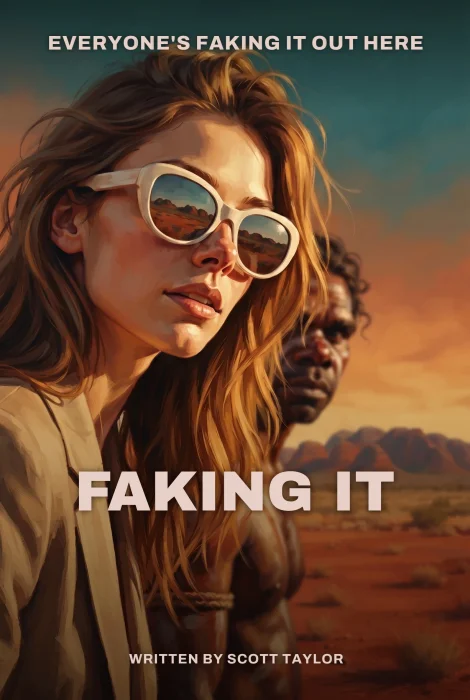
A global pop star fleeing her manufactured image gets lost in the Australian Outback and is rescued by an unemployed ex-stockbroker who fakes being a traditional survivalist to impress her, and both must decide whether to keep performing or finally be seen.
This is a fish-out-of-water romantic comedy built on a clean mirrored-deception hook: Jade is faking her pop-star persona (the vegan lie, the manufactured 'naughty girl' image) at the same time Michael is faking cultural authority he doesn't actually have, and the script is smart enough to have a character say the theme out loud - 'if you're faking it, they're not really liking you' (p.30 est). The Outback setting and the tabloid-satire framing device (E News segments bookending the story) give it a distinct commercial shape, and Benny is a genuinely vivid comic voice. Where it struggles is in the back half: the betrayal is discovered and largely resolved inside a handful of pages, the industry-as-antagonist (Harley) never gets confronted or changed, and the climactic redemption - Michael donating his $300k interview fee - lands as a surprise announcement on live TV rather than something we watched him earn. The middle act also repeats the same campfire 'confession' beat several times without escalating it, and a number of the outback/culture jokes (the loincloth gag, invented Dreamtime stories, the koala-meat bit) sit uneasily next to the film's late, sincere turn toward respecting Michael's heritage. The bones of a good, sellable romcom are here; the execution needs tightening in the second half and a harder look at what the comedy is actually laughing at.
Overboard · Notting Hill · Crocodile Dundee · Music and Lyrics
Mainstream date-night and streaming romcom audiences drawn to celebrity-and-music premises, likely skewing female 18-40, with crossover appeal for anyone who enjoys fish-out-of-water/exotic-location comedy.
The central idea - a pop star escaping her fabricated image collides with a man fabricating his own - gives the story a real reason to exist beyond 'celebrity gets lost in the wilderness.' It's not just a rescue romance; it's built so that the deception on one side mirrors and comments on the deception on the other, which is a sturdier idea than the genre usually bothers with. The opening promise (tabloid machine vs. authentic self) is clearly staked out in the first ten pages via the E News framing and the MTV wardrobe malfunction, and the script does return to that promise at the climax when Jade sings her own song in defiance of her manager. The premise is more clever than original - it's still a two-hander fish-out-of-water romance - but it earns its concept honestly rather than coasting on the exotic backdrop alone.
JADE: I’m not faking. I’m re-framing my image.p.30 — explicitly states the mirrored-deception theme from Jade's side
JADE - NAUGHTY GIRL TOUR. BANGKOK - NOVEMBER 2, 3, 5.p.1 — the manufactured public image the whole story pushes against
MICHAEL: I know he’s out there somewhere.p.24 — Michael maintaining his own fabrication in parallel to Jade's
The inciting incident (Michael finding Jade) lands at a reasonable point, and the deception is planted early and consistently. But the back half rushes: the discovery of the lie, the falling-out, the emu comedy set piece, the cliff-jump near-drowning, and the reconciliation all happen inside a compressed stretch, so none of them get room to breathe as their own beat - the tone whipsaws from betrayal to slapstick to near-death to tenderness within a handful of pages. The middle act also repeats itself: there are several near-identical campfire scenes in which Michael and Jade circle the same 'you don't know the real me' territory without escalating the stakes each time. Most damagingly, Harley and the tabloid machine are set up as the story's real antagonist force but never get an actual confrontation or consequence - he exits the story unchanged, still congratulating himself, which leaves Jade's 'reclaiming herself' climax without an opponent to actually defeat. The ending resolves via a surprise reveal (Michael donating the fee) delivered live on television rather than a choice the audience watches him make.
HARLEY: Whatever happened out there worked for us, trust me. You’ve got guys the world over wanting to rescue you.p.90 — Harley is never actually opposed or changed by the story's end
INTERVIEWER: I should let our viewers know you’ve requested the entire fee for tonight’s interview to be paid to indigenous educational programs.p.96 — the redemption twist arrives as an announcement rather than an earned choice we've watched build
JADE: You fucking liar! Jesus! Why do I keep falling for this shit?p.55 — the betrayal/rupture beat, which is resolved only a handful of pages later
Both leads have concrete, trackable wants: Jade wants to be liked for herself rather than her image ('I wanted to feel like a regular person for a while. Find some solitude,' p.20), and that want survives all three acts, resolving in a public act of defiance against her manager. Michael's want shifts from impressing Jade to genuinely valuing her, tracked through a specific negotiation with Benny for more time ('I want more time to get to know her, nothing else,' p.44) - a concrete stake rather than a vague feeling. Benny is the liveliest supporting character, given real specificity (missing tooth, forged bird-shit face paint, mercenary streak) rather than existing only to serve plot. Where the character work falls down is the industry side: Harley and the news anchor exist purely as caricature engines for satire and never develop or get challenged, which flattens what should be Jade's real opposition. Dwayne is a nice, consistent comic throughline (loyal, deadpan, unfazed) but is never given his own stake in the story beyond function.
MICHAEL: I want more time to get to know her, nothing else.p.44 — Michael's want made concrete and stated plainly
JADE: I wanted to feel like a regular person for a while. Find some solitude.p.20 — Jade's driving want, established early and paid off at the concert climax
HARLEY: That’s what I like to hear, you and me back on the same page!p.91 — Harley never learns anything or changes across the story
Benny has a genuinely distinct voice - blunt, profane, funny, and specific to the character rather than generic wit - and it's the strongest writing in the script. The two leads land some good exchanges built on the theme rather than plot mechanics ('But if you're faking it, they're not really liking you,' p.30). But the script leans on exposition dumps to move plot, most visibly through the news-anchor device, which delivers backstory in single overloaded sentences rather than dramatized scenes. Some jokes are clearly the writer's rather than the character's - punchlines that exist to land a laugh on the page rather than emerge from who's speaking - which occasionally flattens both leads into the same register during argument scenes.
BENNY: Every second word is motherfucker.p.6 — specific, character-driven comic voice
Fresh off Jade’s controversial wardrobe ‘malfunction’ at this year’s MTV awards, her management says the cancelled concert was due to flu, but sources close to the singer dispute that story and no one can tell us exactly where the singer is.p.3 — clunky, single-sentence exposition dump via news anchor
JADE: I pay extra for airfares.p.27 — a joke that works because it's specific to a character caught faking sincerity
The mirrored-lying device is a genuine invention worth protecting, and the fabricated 'Wodda-Wodda' Dreamtime mythology is a clever comic beat that pays off later when it's exposed. But structurally this is a well-worn shape - stranded celebrity, hidden identity discovered via tabloid photo, reconciliation via grand public gesture - assembled from parts familiar from Overboard, Crocodile Dundee, and a dozen other 'fame vs. authenticity' romances. More seriously, a significant portion of the comedy runs through Aboriginal culture as a punchline - the loincloth costume gag, the invented sacred sites, the 'koala meat' bit - which sits uneasily beside the film's later, sincere insistence that Michael respect and reconnect with that same heritage. The script doesn't seem to have fully decided whether it's laughing at Michael's ignorance or at the culture itself, and that ambiguity undercuts what should be its most original material.
MICHAEL: this place is Wodda-Wodda... Means ... land gives life, with water and food and... shit.p.22 — a genuinely original comic invention that pays off later
MICHAEL: I might as well be naked!p.10 — cultural costume gag that risks landing as mockery rather than characterization
JADE: So it’s like road kill?p.26 — the koala-meat bit, comedy built on a fabricated cultural detail
The prose is generally efficient and visual - 'A star so big she only needs one name' (p.1) does a lot of work in one line, and the GFX/SUPER shorthand shows a writer thinking in produceable images rather than just prose. But the middle act is padded by several nearly interchangeable 'EXT. WATERHOLE - CAMPSITE - NIGHT' scenes that repeat the same beat (guilt, teasing, near-confession) without moving the story forward each time, and two or three of these could be cut or merged without losing anything. The ending compresses a great deal of plot - the return to civilization, the TV interview, the backstage crosscut, the concert climax - into a small number of pages, which reads as the story running out of room rather than an intentional acceleration.
A poster of JADE... The poster shows Jade in full flight, performing, hair slick with sweatp.1 — efficient, visual scene-setting
EXT. WATERHOLE - CAMPSITE - NIGHTp.38 — one of several near-identical repeated scene headings/beats in the middle act
Benny’s truck looks tiny against the vast flat outback landscape.p.77 — concise, well-judged descriptive line doing scenic work economically
This has real commercial shape: an exotic, photogenic setting, a built-in soundtrack of original songs, a pop-star lead role that's an obvious casting hook, and a tabloid-satire angle that plays well in trailers. It sits comfortably alongside mid-budget studio and streamer romcoms that have performed reliably. The countervailing risk is the cultural material discussed above - a script this reliant on Aboriginal-culture-as-comedy will likely draw a sensitivity note from any buyer today, and that note would require more than a line pass to address. As written, it's a sellable pitch that would need a genuine revision pass on its comic engine before most buyers would greenlight it without reservation.
EXT. AUSTRALIA - OUTBACK ROAD - DAY / The sun blazes over the baked expanse of the spectacular Australian Outback.p.4 — the exotic, trailer-ready setting
Lyric: The Brave Ones Dancep.38 — built-in original music gives soundtrack/marketing tie-in potential
MICHAEL: I might as well be naked!p.10 — the kind of cultural-comedy material likely to draw studio/sensitivity concern
The second half of the script needs to slow down and let its two biggest turns - the betrayal and the redemption - actually be dramatized rather than announced. Right now the tabloid reveal is resolved almost as fast as it's raised, and the climax's grand gesture (giving away the $300k) is delivered as information on a TV screen rather than a choice the audience watches Michael make. Fixing the pacing and earning both of these beats would do more for the script than any line-level polish.
Give the tabloid-photo betrayal its own full scene sequence with an aftermath before introducing the next comic set piece - let the rupture sit for several pages before the emu chase or any other slapstick beat follows it.
Currently the emotional low point of the story is undercut almost immediately by comedy, which prevents the audience from feeling the stakes of the reconciliation that follows.
pages 55-62
Build Harley into a real antagonist with an actual confrontation or consequence - a scene where Jade directly challenges his control of her image, or where he loses something because of her choice to sing her own song, rather than exiting the story unchanged.
Jade's arc is about reclaiming herself from a manufactured image, but the person controlling that image never actually loses or changes, so her victory has no real opponent.
Harley's scenes throughout, especially the dressing room (p.90) and concert climax (p.100)
Seed Michael's decision to give away the interview money earlier - give him a scene mid-second-act where he wrestles concretely with taking the money versus what it costs him, so the climax payoff is a choice the audience has watched build rather than a surprise announced live on TV.
As written, the film's biggest character turn is delivered as information rather than dramatized change, which weakens the emotional payoff of the ending.
the Benny negotiation scenes (pp.44-46) and the truck ride back (pp.75-82)
Do a full pass on the cultural comedy - the loincloth costume gag, the invented sacred sites, the koala-meat joke - and decide definitively whether the film is laughing with Michael's ignorance (at his expense) or using Aboriginal culture itself as the punchline, then rewrite consistently to the former.
The ambiguity currently undercuts the sincerity of Michael's late reconnection with his heritage and is the single biggest risk to this script getting made as written.
Bungle Bungles costume scene (p.11), koala jokes (p.26), fabricated Dreamtime mythology (throughout Act 2)
Trim two or three of the repeated campfire 'confession' scenes in the middle act (several land the same beat: guilt, teasing, near-admission) and redistribute what's essential from them across fewer, more escalating scenes.
Tightens pacing and prevents the middle act from feeling like it's marking time before the plot resumes.
pages 30-50
Convert the E News anchor exposition dumps into shorter, punchier graphic/soundbite moments rather than paragraph-length explanatory speeches.
Matches the tabloid-satire tone the film is going for rather than explaining the plot in flat news-copy prose.
pp.3, 85
Whether the songs land musically and whether the film's comic tone around Aboriginal culture plays as affectionate or exploitative in performance both depend heavily on directorial and casting choices that can't be assessed from the page alone; the same is true of whether the two leads' chemistry sells the romance quickly enough to cover the compressed back half.
The 5 main characters and 4 minor characters (on the Minor tab) have been added to this script’s Characters list, with whatever the script gave us about each of them. Open one to change anything or to fill in the rest.
This screenplay lives on Script 360.
Write it, break it down, sketch its characters and get coverage on it — then send a page like this one to anybody you like.
Start your own screenplay